
Powered two wheeler riders (excluding micromobility)

Tuesday, March 17, 2026
Social media is deeply intertwined with the daily lives of young people and young adults in Belgium. The rise of platforms such as TikTok, Instagram and YouTube has led to a new dynamic in the dissemination of information and opinions. This study stems from the concern that social media can normalise and even glorify not only positive but also risky behaviour in traffic. The main objective of this study was to map the prevalence, nature and impact of such content and thus contribute to a better understanding of the role of social media in road safety.

Monday, June 30, 2025
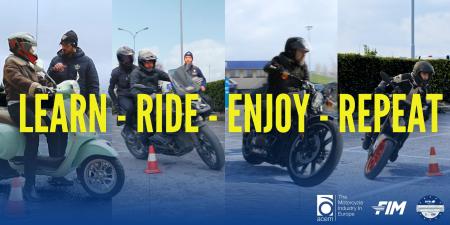
The human factor has repeatedly been shown to be the most critical factor in accidents involving riders. For this reason, lifelong training should be encouraged, reaching out to new and existing motorcyclists. High-quality training is instrumental in achieving the EU safety targets on the way to Vision Zero. To ensure that society fully benefits from all the advantages offered by motorcycles, more work is necessary to further improve the safety record of riders across Europe.

Friday, May 30, 2025
The first major challenge was to make this pastoral action known within the Church's own structure in Ourense. The CEE's Road Pastoral Department was created in Spain more than 50 years ago, but in many dioceses, no initiatives are carried out and priests are unaware of it. The surprising thing was that families, communities, and neighbors, as soon as we began working on these initiatives, began to follow us, asking for more action, and feeling supported in the loneliness caused by the loss of a loved one, a friend, a neighbor, or a car accident. Every year, the number of people participating in the scheduled sessions increases.

Thursday, May 29, 2025
TyreSafe is addressing the critical issue of tyre-related road casualties by equipping all road users with the knowledge to identify and act on poorly maintained or illegal tyres. Our mission follows the Safe System approach, recognising human error and injury tolerances, and aims to eliminate harm through education, engineering, and enforcement. TyreSafe’s focus is on reducing incidents caused by poor tyre maintenance, illegal tread depth, under-inflation, and other defects. Research consistently shows tyres are one of the most neglected safety components. Data from our 2023 Tread Depth Survey revealed over 6 million tyres are replaced annually when already illegal. A 2022 post-collision investigation revealed that 81% of vehicles involved in incidents had tyre defects. Despite this, under-reporting in Police collisions data, Stats19, limits national awareness. TyreSafe’s campaigns, research and stakeholder engagement address this knowledge gap. We work with government, emergency services, tyre industry and other road safety groups to increase understanding and action. TyreSafe’s vision is zero harm from tyre defects on UK roads. By raising awareness, influencing behaviour and advocating for better data and enforcement, we aim to instil long-term change and reduce preventable tyre-related collisions and casualties.
Thursday, May 29, 2025
Children and young people (till 25 years old) make up 41% of the world’s population (United Nations, 2024) and about 25% of this age group is represented in the EU population (Eurostat, 2024). They are an active group, often dependent on public space for movement and social interaction. Yet, that public space is not designed with them in mind, nor does it reflect their world and needs. This has consequences. Every day in Flanders, an average of 10 students (aged 3 to 18) are involved in traffic crashes on their way to school (VIAS Institute, 2019–2023). Over 60% of those victims were walking or cycling. In Europe there were still 455 fatalities amongst children and 2 388 fatalities amongst youth which shows that mobility is not yet inclusive, safe and of high quality for all.
Poorly adapted public space brings dangers and challenges, but it also has more subtle barriers. Children and young people are becoming increasingly less physically active. Regular movement is however essential for both their physical and mental health. One way to encourage this movement is by promoting walking and cycling from an early stage and at a young age.
Inadequate public space also negatively affects the independence of children and young people. About a quarter of students in Flanders are driven by car even for short trips between home and school. That’s unfortunate, because travelling independently helps children learn how to navigate their environment, assess risks, and interact with other road users. This builds confidence and equips them with the skills—and the right—to travel alone.
Poorly adapted public space brings dangers and challenges, but it also has more subtle barriers. Children and young people are becoming increasingly less physically active. Regular movement is however essential for both their physical and mental health. One way to encourage this movement is by promoting walking and cycling from an early stage and at a young age.
Inadequate public space also negatively affects the independence of children and young people. About a quarter of students in Flanders are driven by car even for short trips between home and school. That’s unfortunate, because travelling independently helps children learn how to navigate their environment, assess risks, and interact with other road users. This builds confidence and equips them with the skills—and the right—to travel alone.

Wednesday, May 28, 2025
The stagnation of accident and mortality figures in Spain, particularly regarding run-off-road incidents, demonstrates that traditional road safety solutions, while still essential, have reached their maximum possible impact. Road network authorities must therefore immediately commit to new, disruptive, and innovative measures. An urgent response is required to make the European goal of Zero Victims by 2050 achievable, and this response must be supported by solutions that harness the potential of technology and artificial intelligence.
The main pain points are as follows:
1. High accident rate: Worrying levels of accidents, run-off-road incidents, and pedestrian collisions persist, resulting in severe human and economic consequences.
2. Reactive rather than preventive safety: Existing systems intervene only after an incident to minimise its consequences. There are very few real-time risk detection and alert mechanisms in place.
3. Lack of connected response: There are no infrastructure-based solutions capable of automatically detecting incidents or run-off-road events unless incorporated by the vehicle itself, which often leads to critical delays in notifying emergency services or alerting other road users.
4. Limited technological adaptability: Many roads lack basic supplies such as electricity or signal coverage for remote management.
5. Level of investment: While national authorities are progressively beginning to invest in advanced technological solutions, budgets remain limited, often restricted to pilot programmes and trials without genuine commitment. In numerous regional and local administrations, no officials have yet been appointed for road modernisation or digital transformation, and no budgets are allocated for these matters.
6. Digital technological expertise among road administrators: There is a clear shortage of technical profiles with expertise in IT or telecommunications, and public administrations are slow in equipping themselves with such profiles.
7. The challenge of intelligent infrastructure and the connected vehicle: There is an urgent need to seek alternatives to large-scale V2X (vehicle-to-everything) communication protocols between vehicles or between vehicles and infrastructure, as these may not prove effective in the short term due to factors such as public investment levels, the gradual renewal of the vehicle fleet, or the complexity of harmonising protocols across manufacturers and countries. Tactical solutions that demonstrate real, immediate impact are critically needed.
These are the principal pain points slowing the advancement of smart road deployment, understood as an entire ecosystem of connected, proactive, and preventive solutions to ensure safe, sustainable, and intelligent mobility.
The main pain points are as follows:
1. High accident rate: Worrying levels of accidents, run-off-road incidents, and pedestrian collisions persist, resulting in severe human and economic consequences.
2. Reactive rather than preventive safety: Existing systems intervene only after an incident to minimise its consequences. There are very few real-time risk detection and alert mechanisms in place.
3. Lack of connected response: There are no infrastructure-based solutions capable of automatically detecting incidents or run-off-road events unless incorporated by the vehicle itself, which often leads to critical delays in notifying emergency services or alerting other road users.
4. Limited technological adaptability: Many roads lack basic supplies such as electricity or signal coverage for remote management.
5. Level of investment: While national authorities are progressively beginning to invest in advanced technological solutions, budgets remain limited, often restricted to pilot programmes and trials without genuine commitment. In numerous regional and local administrations, no officials have yet been appointed for road modernisation or digital transformation, and no budgets are allocated for these matters.
6. Digital technological expertise among road administrators: There is a clear shortage of technical profiles with expertise in IT or telecommunications, and public administrations are slow in equipping themselves with such profiles.
7. The challenge of intelligent infrastructure and the connected vehicle: There is an urgent need to seek alternatives to large-scale V2X (vehicle-to-everything) communication protocols between vehicles or between vehicles and infrastructure, as these may not prove effective in the short term due to factors such as public investment levels, the gradual renewal of the vehicle fleet, or the complexity of harmonising protocols across manufacturers and countries. Tactical solutions that demonstrate real, immediate impact are critically needed.
These are the principal pain points slowing the advancement of smart road deployment, understood as an entire ecosystem of connected, proactive, and preventive solutions to ensure safe, sustainable, and intelligent mobility.

Wednesday, May 28, 2025
In Valladolid, one of the main road safety challenges we identified was the safety of children on school routes, especially at intersections with high vehicle flow and limited visibility. Traditional pedestrian crossings, marked only by paint, often fail to capture drivers’ attention — particularly during early morning or late afternoon hours when light conditions are poor, and traffic is dense.
Children, due to their smaller size and unpredictable behavior, are among the most vulnerable road users. Despite the presence of static signage, many drivers fail to reduce speed near school zones, and pedestrians, especially children, faced heightened risks when crossing.
We addressed this issue by implementing the Retrolight System®, an innovative smart crosswalk solution with embedded LED panels and intelligent vertical signage, in one of Valladolid’s key school routes. The system uses real-time sensors to detect pedestrians’ intention to cross and activates dynamic lighting both on the ground and in vertical signs, immediately alerting approaching drivers. By combining active visual cues with automated detection, the system significantly improves pedestrian visibility, raises driver awareness, and ultimately reduces crossing-related risks. This project serves as a replicable model for enhancing safety on school routes across urban environments.
Children, due to their smaller size and unpredictable behavior, are among the most vulnerable road users. Despite the presence of static signage, many drivers fail to reduce speed near school zones, and pedestrians, especially children, faced heightened risks when crossing.
We addressed this issue by implementing the Retrolight System®, an innovative smart crosswalk solution with embedded LED panels and intelligent vertical signage, in one of Valladolid’s key school routes. The system uses real-time sensors to detect pedestrians’ intention to cross and activates dynamic lighting both on the ground and in vertical signs, immediately alerting approaching drivers. By combining active visual cues with automated detection, the system significantly improves pedestrian visibility, raises driver awareness, and ultimately reduces crossing-related risks. This project serves as a replicable model for enhancing safety on school routes across urban environments.

Tuesday, May 27, 2025
Due to the specific characteristics of the Warmian-Masurian Voivodeship — extensive forested areas, type of the road infrastructure, and the predominance of single-carriageway, two-way roads — we record a higher-than-average number of severe traffic incidents compared to the national average. These include collisions with wild animals, crashes into roadside trees, and head-on vehicle collisions. Statistically, these are the leading causes of fatal accidents in our region. If we were able to reduce the number of such incidents to the national average, then — considering the number of fatalities — we would have a real chance of becoming the safest voivodeship in Poland. We recognize the need for infrastructural improvements: traffic separation, reducing the number of potentially hazardous objects within the road zone, and, equally important, the need to change driver behavior. Excessive speed is a common factor contributing to accidents, which we, as the Police, strive to address through monitoring and speed enforcement. However, we believe that effective educational initiatives can bring measurable improvements in road user awareness and, in turn, lead to meaningful changes in behavior on the road.

Monday, May 26, 2025
Road crashes is a major societal problem worldwide, especially in cities where pedestrians, cyclists and motorcyclists are highly exposed and vulnerable in case of a collision. The new policy of city-wide 30 km/h speed limit is intended to ensure vulnerable road users’ safety accounting for 70% of deaths in road crashes in urban areas in Europe.
Scientists urge continuously for lower speeds; however, speeding remains a model and sought behaviour among most drivers and riders, especially the young. The voices of vulnerable road users for less speeding remain weak towards our long-established car and speed-centred societies.
The National Technical University of Athens (NTUA) launched the innovative and original 30 Marathons in 30 months campaign (www.georgeruns30x30.com), aimed at promoting city-wide 30 km/h speed limit in all cities worldwide, as a key policy for safer, healthier and greener cities for all. The NTUA campaign was implemented by the internationally renowned NTUA Professor George Yannis, who is ranked 2nd in Europe and 9th worldwide in road safety science, and supported by the NTUA Road Safety Observatory (https://www.nrso.ntua.gr), a Centre of Research and Innovation Excellence on road safety with global recognition.
This impactful campaign represents a major shift towards a more human-centred approach to urban planning, where people are at the heart of design decisions.
Scientists urge continuously for lower speeds; however, speeding remains a model and sought behaviour among most drivers and riders, especially the young. The voices of vulnerable road users for less speeding remain weak towards our long-established car and speed-centred societies.
The National Technical University of Athens (NTUA) launched the innovative and original 30 Marathons in 30 months campaign (www.georgeruns30x30.com), aimed at promoting city-wide 30 km/h speed limit in all cities worldwide, as a key policy for safer, healthier and greener cities for all. The NTUA campaign was implemented by the internationally renowned NTUA Professor George Yannis, who is ranked 2nd in Europe and 9th worldwide in road safety science, and supported by the NTUA Road Safety Observatory (https://www.nrso.ntua.gr), a Centre of Research and Innovation Excellence on road safety with global recognition.
This impactful campaign represents a major shift towards a more human-centred approach to urban planning, where people are at the heart of design decisions.