
Powered two wheeler riders (excluding micromobility)
Monday, June 24, 2024
We’re addressing multiple road safety problems:`
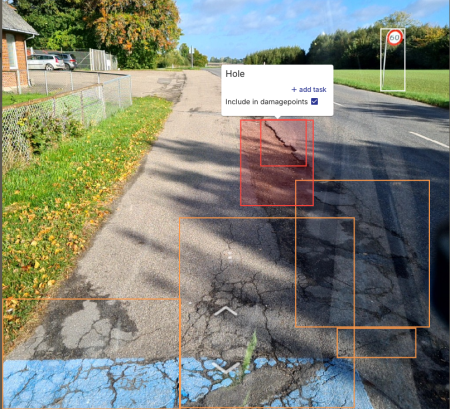
- Improving the work safety of road inspectors by reducing time being physically in the middle of the road and reducing multitasking while driving.
- Improving road safety for cars, motorcycles and bicyclist by reducing potholes and defect road inventory such as faded road signs, damaged bollards, etc.
- Improving road safety for pedestrians by mapping crosswalks with worn-out lane markings as well as pavement uplift that causes people to fall.
Image examples can be found attached
- Improving the work safety of road inspectors by reducing time being physically in the middle of the road and reducing multitasking while driving.
- Improving road safety for cars, motorcycles and bicyclist by reducing potholes and defect road inventory such as faded road signs, damaged bollards, etc.
- Improving road safety for pedestrians by mapping crosswalks with worn-out lane markings as well as pavement uplift that causes people to fall.
Image examples can be found attached

Sunday, June 23, 2024
The Mobilidata program addresses the lack of centralized, timely and qualitative real time traffic warnings in the G2B2C ecosystem.
To fulfil the need of road users to receive and be able to cooperate with (return) real time traffic warnings, Mobilidata implemented for the entire Flanders- region and on the entire public road network the European defined C-ROADS standardized Cooperation model of C-ITS or Cooperative ITS. In Mobilidata 31 different use cases are addressed – see overview of all use cases under 7.2 -images
Mobilidata is the Flanders hub where real time road safety related information comes together from these sources:
• Governmental regional and local level: e.g. roadside infrastructure like traffic controllers, variable message signs,
• Private/corporate level: e.g. Directive 2010/40/EU, EU specified SRTI (safety related traffic information) - vehicle sensor based real time warnings.
• Road user ‘community’ based: Events reported, and event feedback generated by road users.
Each of these 3 source information systems has its strengths and weaknesses, offering a neutral environment where they can be combined and distributed to all interested in a non-commercial setting is possible in a road-safety promoting context.
Road safety information in Mobilidata can be clustered in 3 subgroups per topic in the 29 on-street use case list + an extra subgroup of 2 off-street policy related use cases:
• Road regulation & policies
• Warnings / dangerous situations
• Connected infrastructure / traffic lights
To fulfil the need of road users to receive and be able to cooperate with (return) real time traffic warnings, Mobilidata implemented for the entire Flanders- region and on the entire public road network the European defined C-ROADS standardized Cooperation model of C-ITS or Cooperative ITS. In Mobilidata 31 different use cases are addressed – see overview of all use cases under 7.2 -images
Mobilidata is the Flanders hub where real time road safety related information comes together from these sources:
• Governmental regional and local level: e.g. roadside infrastructure like traffic controllers, variable message signs,
• Private/corporate level: e.g. Directive 2010/40/EU, EU specified SRTI (safety related traffic information) - vehicle sensor based real time warnings.
• Road user ‘community’ based: Events reported, and event feedback generated by road users.
Each of these 3 source information systems has its strengths and weaknesses, offering a neutral environment where they can be combined and distributed to all interested in a non-commercial setting is possible in a road-safety promoting context.
Road safety information in Mobilidata can be clustered in 3 subgroups per topic in the 29 on-street use case list + an extra subgroup of 2 off-street policy related use cases:
• Road regulation & policies
• Warnings / dangerous situations
• Connected infrastructure / traffic lights
Saturday, June 22, 2024
Governments and administration need to do more to improve road safety. But, the statistics for road traffic accidents are still shocking. Around 90% of all road accidents are caused by human error. That means every year, about a million people die because of other people's mistakes, carelessness, or irresponsibility. So it makes you wonder, are we doing good enough for road safety? Safe Driving, aims to help and informing whole road users about every single issue in Road Traffic from A to Z.
Wednesday, June 19, 2024
Between 2018 and 2022 there where 93 fatalities and 894 serious injury collisions in Irish roads which involved motorcyclists. No specific road safety programme aimed at motorcyclists existed at that time. It was identified that the vast majority of these collisions occurred over the Summer months and almost 50% at weekends and many involved leisure riders or those retuning to motorcycling. Ireland has a large number of rural roads, ideal for leisure riding but this also increases risk through road topography and additional hazards which adversely impact motorcycle safety compared to other road users.
Wednesday, June 19, 2024
Asociatia Drum Sigur analyzed and researched the following design errors:
- incorrect use of signs for yielding priority in intersections (Give Way and Stop signs) (error found in most countries of the world)
- the formulas used to calculate the length of acceleration/deceleration lanes at road junctions are incorrect (they do not take into account the impact of heavy vehicle traffic, as well as the volume of traffic flows) (error found worldwide)
- the use of staggered pedestrian crossings at traffic lighted intersections has negative effects on pedestrian traffic in most cases. (case analysis for all the staggered pedestrian crossings in Bucharest)
- identification of design and execution errors for T-type intersections, roundabouts, turbo-roundabouts or interchanges in some cities in Romania.
- analyzing some design errors on certain streets in Bucharest and proposing measures to improve road safety and traffic flow.
- incorrect use of signs for yielding priority in intersections (Give Way and Stop signs) (error found in most countries of the world)
- the formulas used to calculate the length of acceleration/deceleration lanes at road junctions are incorrect (they do not take into account the impact of heavy vehicle traffic, as well as the volume of traffic flows) (error found worldwide)
- the use of staggered pedestrian crossings at traffic lighted intersections has negative effects on pedestrian traffic in most cases. (case analysis for all the staggered pedestrian crossings in Bucharest)
- identification of design and execution errors for T-type intersections, roundabouts, turbo-roundabouts or interchanges in some cities in Romania.
- analyzing some design errors on certain streets in Bucharest and proposing measures to improve road safety and traffic flow.
Monday, June 17, 2024
From July 2024, stricter EU regulations (GSR II) will come into force for all newly registered trucks and buses. Most of these also apply to city buses. An important exception in GSR II is the emergency braking assistance system, which is not mandatory for buses with unprotected standing and seated passengers. For this type of city bus, ZF has developed a brake assistance system that reduces the consequences of a possible collision. It contains a braking cascade which starts with a first braking pulse which enables sufficient reaction time for standing passengers in order to prepare for the actual braking maneuver, for example by holding and/or a compensating step. The deceleration is then raised to a conservatively selected value which is still controllable for standing passengers and at the same time represents a satisfactory balance with the desired reduction in the vehicle speed and the reduction in the severity of the collision. The Collision Mitigation System (CMS) protects both passengers and vulnerable road users and enables a safer urban public transport.
Monday, June 17, 2024
Our experience shows that most road accidents are caused by human error. Various analyses carried out by ALSA show that most road accidents are caused by inappropriate driver behaviour.
In order to manage road safety proactively, it is necessary to have a detailed and rigorous knowledge of the performance and behaviour of each driver in order to know their skills and behaviours, as well as to track their evolution over time.
To this end, ALSA has invested in technology in more than 3,700 vehicles in Spain that allows us to measure speeding, monitor various parameters that reflect driving style and detect various driver behaviours using innovative smart camera technology.
These smart cameras are based on "machine vision” and "artificial intelligence" (MV+IA) systems, which allow us to detect 40 types of driver behaviour and are particularly noteworthy for their innovation.
The data provided by the aforementioned technologies is used to calculate the risk profile of each driver. ALSA defines personalised actions for each driver: training, assignment to certain vehicles and routes, greater follow-up and monitoring, etc.
In addition, each driver has access to the data available on their own performance through an internal app (called "MiAlsa"). In this way, drivers can consult information on their own performance (consumption, driving styles, speeding, incidents, etc.).
In order to manage road safety proactively, it is necessary to have a detailed and rigorous knowledge of the performance and behaviour of each driver in order to know their skills and behaviours, as well as to track their evolution over time.
To this end, ALSA has invested in technology in more than 3,700 vehicles in Spain that allows us to measure speeding, monitor various parameters that reflect driving style and detect various driver behaviours using innovative smart camera technology.
These smart cameras are based on "machine vision” and "artificial intelligence" (MV+IA) systems, which allow us to detect 40 types of driver behaviour and are particularly noteworthy for their innovation.
The data provided by the aforementioned technologies is used to calculate the risk profile of each driver. ALSA defines personalised actions for each driver: training, assignment to certain vehicles and routes, greater follow-up and monitoring, etc.
In addition, each driver has access to the data available on their own performance through an internal app (called "MiAlsa"). In this way, drivers can consult information on their own performance (consumption, driving styles, speeding, incidents, etc.).

Sunday, June 16, 2024
We are addressing road safety for motorcyclists safety and innovative, pragmatic infrastructure solutions, that are working and can be applied on the roads, mainly for pro-active approach, and as well as active (passive safe).
Saturday, June 15, 2024
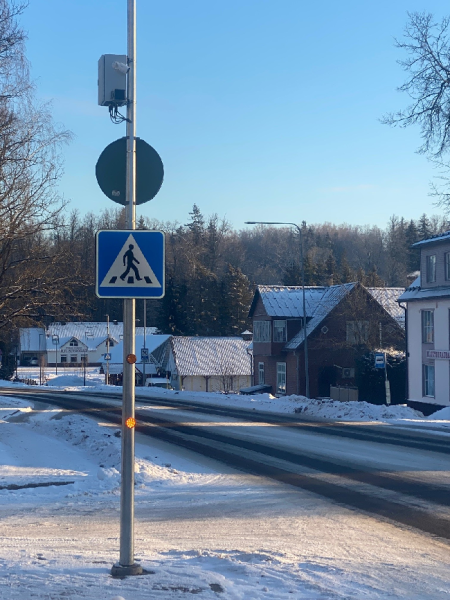
The main road safety challenge that was tackled in this initiative is safety of the pedestrians and drivers on the main street of Põlva. The daily traffic volume on this road segment is high, with approximately 5000 vehicles, including trucks, passing through it every day. Simultaneously, high number of pedestrians use the same road daily to get to work or school. From a traffic safety perspective, this road segment is challenging – the hilly and winding road can distract drivers from speed limits, and the increased prevalence of light vehicles (bicycles, scooters etc) further amplifies the danger of this situation.
Smart Road is a vision of the future street, where all road users are equally preferred, and the emphasis is no longer solely on cars. Smart Road is designed to encourage drivers to objectively consider their traffic behaviour and to pay more attention to vulnerable road users. At the same time, the creators of Smart Road understand that vulnerable road users are indeed more difficult to notice, and effective solutions must be provided to assist drivers in focusing their attention on them.
Smart Road is a vision of the future street, where all road users are equally preferred, and the emphasis is no longer solely on cars. Smart Road is designed to encourage drivers to objectively consider their traffic behaviour and to pay more attention to vulnerable road users. At the same time, the creators of Smart Road understand that vulnerable road users are indeed more difficult to notice, and effective solutions must be provided to assist drivers in focusing their attention on them.
Friday, June 14, 2024
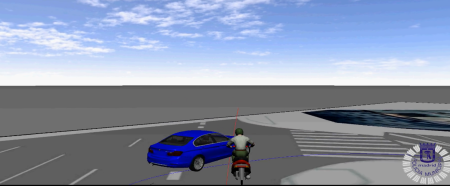
El desafío es implementar una iniciativa que permite mejorar y poner en práctica acciones que reduzcan los enclaves de concentración de accidentes, recogiendo el propósito de “Avanzar juntos hacia una movilidad segura”, compartiendo y comprometiéndonos a conseguir unos objetivos, desarrollando unas actividades que permite abordar con éxito el problema de la seguridad vial urbana en la Ciudad de Madrid, la segunda Ciudad Europea con mayor población.