

Powered two wheeler riders (excluding micromobility)

Friday, May 9, 2025
In the Maritime Neighbourhoud of Molenbeek, we identified multiple road safety barriers that disproportionately affect children and women. Many vulnerable residents, especially children, do not have access to a bike or a safe space to ride, making it difficult to learn and practice cycling. Public space is often dominated by car traffic, and children are rarely given the opportunity to move independently and safely. Additionally, many women never learned to ride a bicycle or have lost confidence due to long-term disuse and fears around traffic. A lack of infrastructure, awareness, and cycling culture further limits active mobility. Through Openstreets, we tackled these challenges by creating car-free zones, offering safe spaces for learning, practicing, and enjoying cycling. We provided access to bikes, organized lessons for women and children, and ensured on-site bike repair services. This comprehensive approach helped remove practical, cultural, and emotional barriers to cycling. In doing so, we promoted cycling as a safe, accessible, and empowering mode of transport and helped shift perceptions of who “belongs” on the road.
Wednesday, May 7, 2025
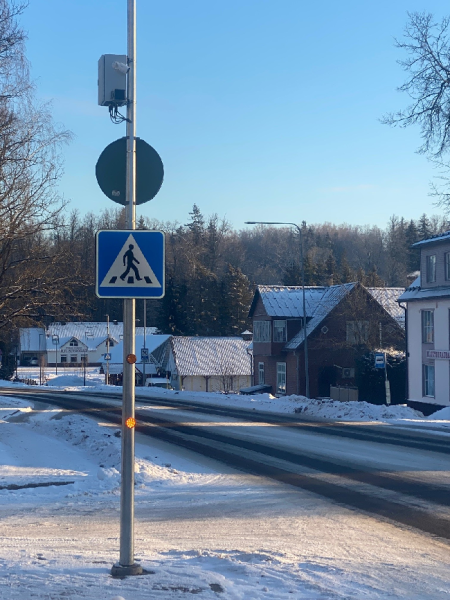
The main road safety challenge addressed in this initiative was ensuring the safety of both pedestrians and drivers along the main street of Põlva, Estonia. This road segment experiences a high daily traffic volume—around 5,000 vehicles, including heavy trucks—while also serving as a key pedestrian route for people commuting to work, school, or public services.
From a safety perspective, the road presents multiple risks: its hilly and winding layout can distract drivers and encourage speeding, and the growing use of light mobility vehicles such as bicycles and scooters increases the complexity of traffic interactions. These conditions create a hazardous environment for vulnerable road users.
The Bercman Smart Road represents a forward-looking approach to urban street design—one where all road users are given equal priority, and the focus shifts away from cars alone. The system is designed to encourage drivers to reflect on their behaviour and increase their awareness of pedestrians and cyclists. At the same time, it recognises that vulnerable road users are not always easily visible and provides intelligent support systems to help drivers notice and respond to them more effectively.
Tuesday, May 6, 2025
While road safety efforts often focus on prevention and driver behavior, a critical yet under-recognized issue is the post-accident condition of roadways. Hazardous residues such as oil, fuel, and vehicle debris left after a traffic incident significantly increase the risk of secondary accidents, especially in urban environments with high traffic flow or during adverse weather conditions.

It is estimated that up to 7% of road accidents are directly caused by solid or liquid waste remaining on the roadway following previous incidents. Despite this, post-accident cleaning is frequently inconsistent, delayed, or not conducted in accordance with environmental regulations.

Our initiative addresses this gap by offering a nationwide, 24/7 emergency intervention service focused on restoring road safety and environmental conditions after accidents. Activated by Civil Protection or law enforcement, our patented equipment and trained teams clean, decontaminate, and report damage with full traceability. We also georeference each intervention, helping municipalities identify accident hotspots and improve their prevention strategies.

By acting immediately after incidents, we not only reduce accident recurrence but also promote environmental compliance, public safety, and operational efficiency. Our service transforms a reactive task into a strategic road safety solution.
Friday, May 2, 2025
Veilig Over is een initiatief dat ernaar streeft voetgangers veilig te laten oversteken en dat bovendien iedereen toestaat om ook zélf aan te duiden waar er nood is aan een veilige oversteekplaats, via een onlineplatform veiligover.be. Samen oversteken veilig maken, dat is de ambitie van ‘Veilig Over’. Dit doen we met een unieke samenwerking met lokale en regionale overheden & burgerparticipatie en citizen sciene & wetenschappelijke evaluatie (met Vias institute). Dit alles met als resultaat: de concrete verwezenlijking van een veilige oversteekplaats op het terrein!
Thursday, April 24, 2025
Due to the necessities of the road network, generally road works occur whilst roads are still open for use by all classes of road users. Hence it is important that the pedestrian, vehicular and cycling traffic is designed and managed to reduce the safety risks of users.
Research has shown that the risk of a serious traffic collision at or in a road works site is three to five times more than on other parts of the road network (CAREC, 2018).
The implementation and maintenance of the road safety measures at work sites is important but it is equally important that all road users understand and appreciate the safety risks and the operational aspects of such work sites.
We have identified the need for specific Road Safety Awareness Education and Training with FOCUS ON WORK SITES. This aspect is commonly omitted from general Road Safety Education Programmes. Road users, namely passengers, drivers, cyclists and pedestrians across different age groups are addressed.
Thursday, April 24, 2025
Driving in the wrong direction (commonly referred to as “kamikaze driving”) is one of the most dangerous incidents on roads and highways. In Spain alone, according to the Spanish Traffic Management Center (DGT), over 300 wrong-way driving incidents are reported each year. Studies show that wrong-way crashes are up to 27 times more likely to result in fatality compared to other types of highway accidents.
This type of incident often stems from driver confusion, impairment (e.g., alcohol or drugs), or poor signage, and poses a critical challenge for traffic safety authorities and infrastructure operators across Europe.
PROIN-iWrongWay is an intelligent traffic safety system designed to detect vehicles driving in the wrong direction on roads and highways. The system uses real-time monitoring to identify reverse traffic incidents and immediately activates roadside warning signals to alert the driver. Simultaneously, it notifies local authorities for rapid response and incident management.
The system is fully connected to PROIN’s IoT platform (ProinCloud), enabling remote monitoring, data analytics, and system diagnostics. It also integrates seamlessly with external smart city and ITS platforms such as Sentilo and others, ensuring full interoperability.
Moreover, PROIN-iWrongWay is connected to DGT, allowing for direct coordination and enhanced national-level traffic control.
Wednesday, April 16, 2025
Una delle sfide principali riguarda una cultura radicata che privilegia l'uso dell'automobile, scoraggiando l'adozione di mezzi pubblici e di trasporti alternativi. Questo comportamento si riflette in un mancato rispetto delle normative del codice della strada. Inoltre, c'è una scarsa attenzione verso la protezione degli utenti più vulnerabili, come pedoni e ciclisti. Questo atteggiamento compromette la vivibilità della città, che viene vissuta più come un luogo di transito che come uno spazio di incontro e socializzazione.
Thursday, April 10, 2025
Road safety in Europe and worldwide is still tragically compromised by a high number of accidents and avoidable loss of human lives.

This is compounded by the worrying frequency of vehicle recalls for brake problems, with over 3 million units affected in just two years (ANSA data), a symptom of an intrinsic vulnerability in current systems.

The dependence on rare materials in traditional braking systems and new technologies not only creates economic instability but also generates significant geopolitical implications.

Furthermore, there remains a lack of a reliable and universal mechanical solution capable of improving braking and ensuring safety in the event of failure.

These challenges highlight the urgent need for innovative solutions like DUOBBRAK, capable of overcoming the limitations of current systems, despite the resistance, and mostly the indifference, encountered in promoting it within the industry, accelerators, and public and private institutions
Friday, April 4, 2025
In 2022, 2.017 fatalities happened in the EU where cyclists have been involved representing 10% of all road fatalities.
More than 60% of all accidents between motor vehicles and bicycles occur when turning and crossing because bicycles are not illuminated from the side and the modern front and rear lights fitted emit a very focussed light that cannot be seen from the side.
The side reflectors, which are also mandatory, are only visible when they are illuminated.
For these reasons, both in bad weather and in the dark, bicycles are difficult or impossible to see from the side and are therefore often not noticed when they pass a car on the right-hand side, for example in front of traffic lights.
Bicycles are also difficult to recognise when crossing a road with oncoming traffic, as the multi-LED lights used on motor vehicles today shine much brighter than previous headlights.
Another problem is that car drivers do not keep the required minimum distance. Either because they are unable to judge the correct minimum distance or because they do not recognise bicycles in the dark.
Similarly, motorists are not made aware when they fall below the minimum distance and are therefore unable to react.
Intelligent, reactive lighting systems for bicycles are therefore needed in urban traffic to indicate to motorists the minimum distance to be maintained, warn them if the minimum distance is not observed and provide permanent side lighting for the bicycle.
Wednesday, March 19, 2025
The overall target of the KFV podcast is to provide important and usefull tips for people who care about their personal safety and the well-being of their loved ones in the everyday life.

In each episode of the KFV podcast, two KFV experts talk for around 20 minutes about a topic from everyday life: about current issues of safe road traffic as well as accident-free relaxation during sport and exercise in nature, but also about the pitfalls of getting older as well as the turbulent life with children and teenagers.

With life experience, specialist knowledge and a good dose of humour, both moderators provide important tips and back ground information about accident risks, accident occurrence and accident prevention.

Here is a little taster of the content of the first three episodes published in March 2023, April 2023 and May 2023:


Episode 1: ‘L17: the best route to a driving licence?’

L17 is currently the most comprehensive driver training course on the way to a B driving licence. But driving the first 3,000 kilometres with your own child at the wheel can be nerve-wracking. Is the effort, courage and extra work really worth it?

On air: Monday, 11 March 2023

Episode 2: ‘Starting the motorbike season: why are masking effects life-threatening and ellipses life-saving?’

Motorcycling is back in fashion among the 40-plus generation. Since 2000, the number of motorbikes in Austria has more than doubled. But the streamlined silhouette is also the greatest danger: single-track bikes are virtually invisible in many traffic situations. How can motorcycling remain a safe pleasure?

On air: Monday, 17 April 2023


Episode 3: ‘Children & water: fascination, pleasure, risk. How to ensure water fun - with safety!’

Children and water - that means fun, but it's also a risky combination. For small children, paddling pools just a few centimetres deep can be disastrous if left unattended. What are the best safety measures for swimming pools, garden ponds and the like?

On Air: Monday, 15th May 2023

Since March 2023 the KFV Podcast has been published with a new episode once a month.
Subscribe to Powered two wheeler riders (excluding micromobility)