
Children 0-16
Monday, June 17, 2024
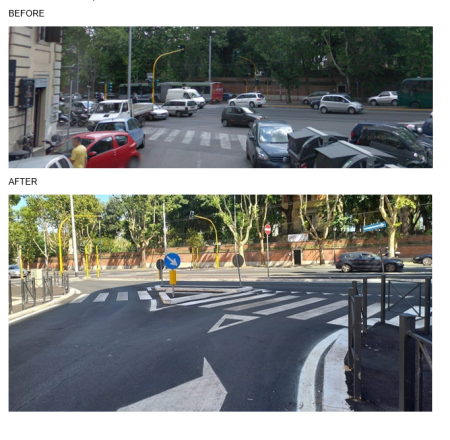
The safety inspections conducted over time on incident-prone areas and the analyses carried out on accident cases through the SISS (Incident Information and Analysis System) present at the Road Safety Competence Center of Rome Capital have allowed for the identification of multiple concurrent elements that can lead to accidents, such as (indicative and non-exhaustive list):
Excessive speed relative to the road's horizontal and vertical characteristics and its context;
Driver distraction due to the use of electronic devices;
Failure to comply with road traffic rules and regulations;
Failure to comply with visibility triangle requirements or minimum safe stopping distances;
Failure to use pedestrian crossings;
Failure to obey traffic signals, either due to a lack of feedback from the signaling system (pedestrian call buttons) or excessively long signal times;
Pedestrian crossings in areas with limited visibility;
Overlap of conflicting functions in the same spaces;
Scooters or bicycles being ridden in pedestrian areas or on sidewalks;
Illegal parking at intersections, on pedestrian crossings, near waste containers, or double parking;
Excessive speed relative to the road's horizontal and vertical characteristics and its context;
Driver distraction due to the use of electronic devices;
Failure to comply with road traffic rules and regulations;
Failure to comply with visibility triangle requirements or minimum safe stopping distances;
Failure to use pedestrian crossings;
Failure to obey traffic signals, either due to a lack of feedback from the signaling system (pedestrian call buttons) or excessively long signal times;
Pedestrian crossings in areas with limited visibility;
Overlap of conflicting functions in the same spaces;
Scooters or bicycles being ridden in pedestrian areas or on sidewalks;
Illegal parking at intersections, on pedestrian crossings, near waste containers, or double parking;

Sunday, June 16, 2024
In the Netherlands cycling is the most important way of daily transportation. Sadly, over the past 10 years the amount of bicycle casualties in the Netherlands has increased by 40%, which is expected to increase even more by the popularity of the E-bike. In 2023, 71.000 cyclists were treated in hospitals (60% of all traffic casualties) with 12.500 having traumatic brain injury (16%). Traumatic brain injury often leads to permanent disability as neurons have no or just little recovery potential. A very simple and effective intervention is the voluntary promotion of bicycle helmet with estimated reduction of death 70% and brain injury by 60%. In Denmark, voluntary promotion of bicycle helmets has been very effective in reducing the amount of casualties, especially in children. When we started in 2022 with the first National Day of the bicycle helmet only 2% of the Dutch cyclists were wearing helmets.
Sunday, June 16, 2024
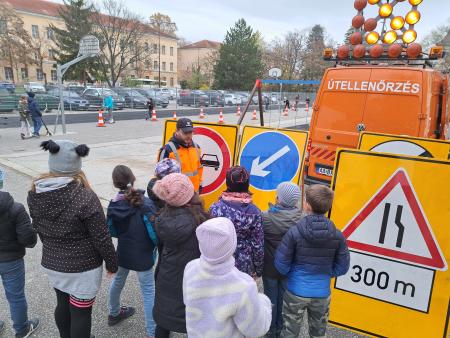
From the first of September 2022, MKIF Magyar Koncessziós Infrastruktursa Fejlsztó Zrt took over the operation, maintenance and development of 1,237 km of existing Hungarian expressways.
When analyzing the accidents recorded by our traffic surveillance cameras on domestic expressways, we noticed that it is important to draw attention to traffic safety in our communication (keeping a following distance, observing the speed limit near work areas, protecting our colleagues, early education of children/young adults in safe traffic) and traffic -culture (littering, driving in an egoistic style that endangers others, early education of children/young adults on responsible driving).
When analyzing the accidents recorded by our traffic surveillance cameras on domestic expressways, we noticed that it is important to draw attention to traffic safety in our communication (keeping a following distance, observing the speed limit near work areas, protecting our colleagues, early education of children/young adults in safe traffic) and traffic -culture (littering, driving in an egoistic style that endangers others, early education of children/young adults on responsible driving).

Sunday, June 16, 2024
In Vienna most parents are afraid to cycle with their kids on the streets because of the lack of proper and continuous infrastructure for bikes. This degenerates the ability of children in Vienna generally reaching an all time low of 17% of children taking a biking license and having over 50% of them fail in the exam due to lack of skill and practical knowledge about road behavior. This further decreases the biking competency of children in secondary school as they don’t have any motivation whatsoever to actually learn biking at a later age. With only 20 km per year of safe biking infrastructure generated and a need for over 300km this creates a gap of centuries while parents wait for safe infrastructure during which biking competencies further deteriorate. the bikebus (Bicibus) provides a method to engage children at the right age to motivate them for biking and educates parents by practicing and by positive example to actually provide a learning opportunity to children, when they actually are prone to learn biking seriously (5-10) This prepares their technical skills so they are ready, when their actual physiology is ready to safely travel through urban traffic alone even without safe infrastructure yet in place.

Sunday, June 16, 2024
Main challanges are to provide Self-Explaining road design around Schools and School areas and where Children walk to School. therefore drivers tend to slow down and become more attentive in traffic, also maximun speeds (Vmax) are much lower.
Consequently Children are more safe going to School and around School areas, drivers drives more safe and with that walkability and using of sustainable transport (public, bikes...) increased.
Consequently Children are more safe going to School and around School areas, drivers drives more safe and with that walkability and using of sustainable transport (public, bikes...) increased.
Saturday, June 15, 2024
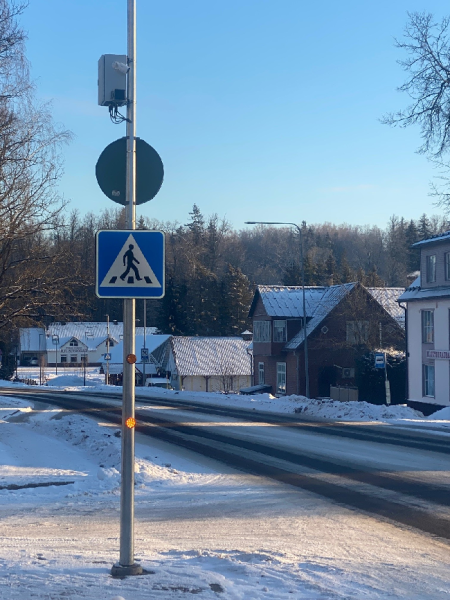
The main road safety challenge that was tackled in this initiative is safety of the pedestrians and drivers on the main street of Põlva. The daily traffic volume on this road segment is high, with approximately 5000 vehicles, including trucks, passing through it every day. Simultaneously, high number of pedestrians use the same road daily to get to work or school. From a traffic safety perspective, this road segment is challenging – the hilly and winding road can distract drivers from speed limits, and the increased prevalence of light vehicles (bicycles, scooters etc) further amplifies the danger of this situation.
Smart Road is a vision of the future street, where all road users are equally preferred, and the emphasis is no longer solely on cars. Smart Road is designed to encourage drivers to objectively consider their traffic behaviour and to pay more attention to vulnerable road users. At the same time, the creators of Smart Road understand that vulnerable road users are indeed more difficult to notice, and effective solutions must be provided to assist drivers in focusing their attention on them.
Smart Road is a vision of the future street, where all road users are equally preferred, and the emphasis is no longer solely on cars. Smart Road is designed to encourage drivers to objectively consider their traffic behaviour and to pay more attention to vulnerable road users. At the same time, the creators of Smart Road understand that vulnerable road users are indeed more difficult to notice, and effective solutions must be provided to assist drivers in focusing their attention on them.
Friday, June 14, 2024
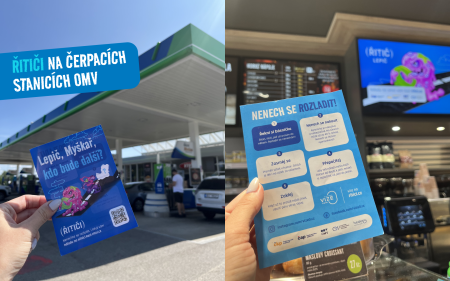
Drivers encounter dangerous situations on the roads daily, arising from aggressive driving behavior. The project DriveArse (Czech: Nenechte se rozladit - Řitiči) indirectly built upon findings from the project Aggression Kills (Agresivita zabíjí by ČAP, BESIP) and systematically used them to create a positive solution in situations where a road user is confronted with aggression behind the wheel.
Previous research (Aggression Kills, ČAP, BESIP) indicate that aggressive driving causes up to 40% of fatal traffic accidents. Aggressive driving is dangerous not only for the drivers themselves but also for those around them. 7 out of 10 drivers admit that they are provoked into aggressive driving and change their own driving style. This is linked to the belief of 88% of Czech drivers in the increasing aggression behind the wheel. Almost 60% of drivers under 30 sometimes intentionally do not maintain a safe distance from the vehicle in front of them, and 20% of them purposely speed up when another car is trying to overtake them. At the same time, 87% of drivers are motivated by the considerate driving of others.
In the case of aggression behind the wheel, the current legislative support in the Czech Republic is rather general and does not contain precise definitions of aggressive behavior behind the wheel, its specific manifestations, or the exact penalties that may be imposed. The DriveArse campaign was therefore carried out together with the efforts of Platforma VIZE 0 for legislative changes, using experiences from selected EU countries where legislation defines what precisely aggression is and imposes specific sanctions.
This project comes up with a positive attitude and wit as a tool to deal with unpleasant situations on the road, while also functioning as a creative research. It presents manifestations of aggression through caricatures of aggressive drivers with creative names. In this way, it helps road users to recognise and name aggressive drivers, as well as not to be provoked by such aggressive drivers and to handle the situation with humour (for example with a rhyme or a funny remark).
Previous research (Aggression Kills, ČAP, BESIP) indicate that aggressive driving causes up to 40% of fatal traffic accidents. Aggressive driving is dangerous not only for the drivers themselves but also for those around them. 7 out of 10 drivers admit that they are provoked into aggressive driving and change their own driving style. This is linked to the belief of 88% of Czech drivers in the increasing aggression behind the wheel. Almost 60% of drivers under 30 sometimes intentionally do not maintain a safe distance from the vehicle in front of them, and 20% of them purposely speed up when another car is trying to overtake them. At the same time, 87% of drivers are motivated by the considerate driving of others.
In the case of aggression behind the wheel, the current legislative support in the Czech Republic is rather general and does not contain precise definitions of aggressive behavior behind the wheel, its specific manifestations, or the exact penalties that may be imposed. The DriveArse campaign was therefore carried out together with the efforts of Platforma VIZE 0 for legislative changes, using experiences from selected EU countries where legislation defines what precisely aggression is and imposes specific sanctions.
This project comes up with a positive attitude and wit as a tool to deal with unpleasant situations on the road, while also functioning as a creative research. It presents manifestations of aggression through caricatures of aggressive drivers with creative names. In this way, it helps road users to recognise and name aggressive drivers, as well as not to be provoked by such aggressive drivers and to handle the situation with humour (for example with a rhyme or a funny remark).
Friday, June 14, 2024
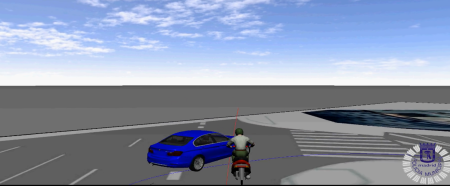
El desafío es implementar una iniciativa que permite mejorar y poner en práctica acciones que reduzcan los enclaves de concentración de accidentes, recogiendo el propósito de “Avanzar juntos hacia una movilidad segura”, compartiendo y comprometiéndonos a conseguir unos objetivos, desarrollando unas actividades que permite abordar con éxito el problema de la seguridad vial urbana en la Ciudad de Madrid, la segunda Ciudad Europea con mayor población.
Thursday, June 13, 2024
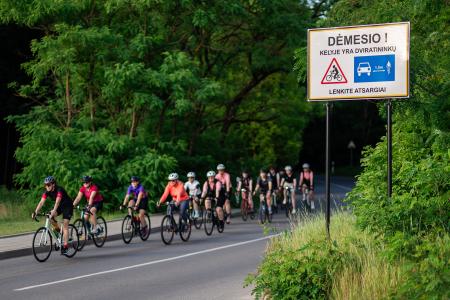
Since our inception in 2017, we have identified major road safety challenges faced by cyclists, primarily related to unsafe overtaking practices. This is a crucial problem, with the number of cyclists steadily increasing each year and many people, particularly in remote areas, relying on cycling for their daily activities. In 2023 alone, eleven cyclists tragically lost their lives in road accidents in Lithuania, an increase from five deaths the year before. In response to these alarming trends, we launched a public campaign targeting both the general public and public authorities. The aim of this campaign is to approve and implement a new road sign that mandates vehicles maintain a safe overtaking distance of at least 1.5 meters from cyclists. This sign, commonly used in many other countries, would be a first for Lithuania.
In collaboration with local authorities, we successfully erected eight such signs in various locations across Lithuania in 2023-2024, largely using our charity funds for this purpose. Our ongoing efforts are now focused on achieving nationwide adoption of this sign, particularly in areas identified as high-risk for cyclists. By doing so, we aim to significantly enhance road safety for cyclists throughout the country.
In collaboration with local authorities, we successfully erected eight such signs in various locations across Lithuania in 2023-2024, largely using our charity funds for this purpose. Our ongoing efforts are now focused on achieving nationwide adoption of this sign, particularly in areas identified as high-risk for cyclists. By doing so, we aim to significantly enhance road safety for cyclists throughout the country.

Thursday, June 13, 2024
According to statistics, road accidents are the leading cause of death for young people, especially in the 18-24 age group. This is a good reason to raise awareness and to leverage the young population.
Many young people and young adults represent an interesting target for awareness campaigns. Not only can they help spreading awareness in society right now, but they are also highly exposed to road risks. Moreover, when properly addressed, younger people are open to learn and to change behaviour.
Motorways, Italian Police and City Authorities decided to reach out to young people by creating a project aimed at road safety culture.
The main goal is to widespread safety culture directly to students and young adults. It is also the opportunity to mobilize a huge number of national, regional and local stakeholders.
Impact and scale: The core of the initiative is made out of 40 events in 6 regions and 20 towns. Organizers expect to reach 10.000 to 20.000 people, ideally 15.000. It’s not just an easy tour of lectures in schools. Strategies for medium/long term engagement are put into practice. A concrete assessment of results is being made.
Many young people and young adults represent an interesting target for awareness campaigns. Not only can they help spreading awareness in society right now, but they are also highly exposed to road risks. Moreover, when properly addressed, younger people are open to learn and to change behaviour.
Motorways, Italian Police and City Authorities decided to reach out to young people by creating a project aimed at road safety culture.
The main goal is to widespread safety culture directly to students and young adults. It is also the opportunity to mobilize a huge number of national, regional and local stakeholders.
Impact and scale: The core of the initiative is made out of 40 events in 6 regions and 20 towns. Organizers expect to reach 10.000 to 20.000 people, ideally 15.000. It’s not just an easy tour of lectures in schools. Strategies for medium/long term engagement are put into practice. A concrete assessment of results is being made.