Hungary

Wednesday, June 24, 2026
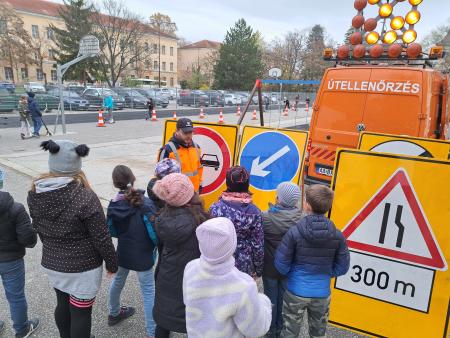
Road safety education must begin in early childhood: the knowledge, habits and attitudes acquired at this age shape a child's behaviour in traffic for life and lay the foundations of later responsible, conscious participation in traffic. In today's stimulus-rich world, however, traditional classroom-based theoretical teaching is not sufficiently effective on its own for this age group, so we complement and combine it with experience-based, practical programmes.
The scale of the problem is reflected in accident data. In the European Union, around 20,400 people died in road accidents in 2023, with vulnerable road users – pedestrians, cyclists and powered two-wheeler riders – accounting for almost half of all fatalities. Children form a particularly sensitive group: in Hungary, between 2019 and 2023, 52 children lost their lives and 763 suffered serious injuries on the roads, and a significant share of these cases is attributable not to the children but to the conduct of adult road users. Achieving the EU's and Hungary's transport policy goals and realising Vision Zero requires regular, early-age educational programmes as instruments of long-term societal attitude change.
The programme therefore builds the foundations of safe mobility from ages 4–10 through experience-based, practical education, while also engaging parents and educators.
Tuesday, June 23, 2026
In Hungary, traffic education is included in the National Curriculum for primary schools (grades 1–8). However, only a limited number of lessons are devoted to this topic – on average three lessons per year – and teaching focuses mainly on theoretical knowledge. Although children are legally allowed to cycle on public roads (except on main roads before the age of 12), many are not adequately prepared for individual, independent and safe cycling.
Recognizing the importance of theoretical and practical cycling education, the Bringasuli team has been developing educational materials, methodologies for cycling education in primary schools (with a focus on 9–12-year-old pupils), and training-of-trainers programmes to equip teachers with the skills needed to deliver practical cycling training.
Since 2016, through two Erasmus+ projects, Bringasuli has developed a comprehensive cycling education programme and organised several training-of-trainers courses for teachers. As a result, a methodology for practical cycling education in primary schools became available. However, there was no opportunity to implement the programme on a national scale.
In 2024, with the support of Active Hungary, a pilot programme was launched to test and further refine the Bringasuli methodology. The positive results of the pilot led to a much more ambitious initiative for 2025–2026, aiming to involve 12,000 children in a nationwide practical cycling education programme.
The programme targets pupils in grades 4–6 and aims to provide them with practical cycling skills that will enable them to cycle individually, independently and safely in everyday traffic.
Friday, June 19, 2026
The program targets the main source of road safety issues: the human factor, and more specifically, the lack of transport culture and partnership. Approximately 90% of road traffic accidents can be attributed to human error, inattention, or rule violations. The main challenges are the ever-increasing aggression, impatience, conscious violation of rules, and distraction caused by modern technology. A further critical problem is that drivers, cyclists, e-scooter users, and pedestrians often view each other as enemies rather than interdependent partners in shared spaces. This flawed mindset increases the number of conflicts and the risk of severe accidents. Instead of traditional authoritative methods relying solely on prohibitions and sanctions, the Program's goal is to apply a comprehensive, educational approach that fosters positive examples, mutual respect, and responsible behavior rather than inducing fear. Changing these attitudes and raising public awareness are essential to achieving the Vision Zero goal set by the European Union. Thus, by directly addressing the root causes of accidents and increasing safety awareness, the program supports this highly important endeavor. The date for the Day of Transport Culture was set to May 11 in honor of the opening day of the UN Decade of Action on May 11, 2011. It was first organized in 2015, and has been held every year since then, with the exception of the pandemic period.
18 May 2026 08:00 – 21 May 2026 16:00
Hungexpo Budapest Congress and Exhibition Centre
Hungary
Sunday, July 13, 2025
The main challenge addressed by this practice is the traditional barrier to entry for deep-tech innovation: the need for large, specialized, and expensive development teams. This often slows down a project's ability to adapt and innovate, especially for mission-driven initiatives with limited initial resources.
Sunday, July 13, 2025
The primary challenge we address is not a single road safety issue, but the systemic limitation of a reactive mindset. Current technology platforms often create data monopolies, lack interoperability, and are driven by profit motives rather than public interest. This creates a barrier to building a truly integrated, trustworthy, and proactive safety ecosystem that public authorities can rely on and help shape.
Sunday, June 16, 2024
From the first of September 2022, MKIF Magyar Koncessziós Infrastruktursa Fejlsztó Zrt took over the operation, maintenance and development of 1,237 km of existing Hungarian expressways.

When analyzing the accidents recorded by our traffic surveillance cameras on domestic expressways, we noticed that it is important to draw attention to traffic safety in our communication (keeping a following distance, observing the speed limit near work areas, protecting our colleagues, early education of children/young adults in safe traffic) and traffic -culture (littering, driving in an egoistic style that endangers others, early education of children/young adults on responsible driving).

National Relay Event of the KTI

As National Relay, KTI Hungarian Institute of Transport Science and Logistics Nonprofit Kft.  organized the National Relay event on May 10, 2023, the purpose of which is to introduce and popularize the Charter in Hungary. The event created an opportunity for members to share their knowledge and experience; and introduced the Charter to the stakeholders involved in traffic safety and encouraged them to join. The National Relay Event was a professional conference where good national and foreign traffic safety practices were presented and discussed.

Friday, June 17, 2022
Magyarországon annak ellenére nem létezik szisztematikus kerékpáros közlekedésre nevelés sem a közoktatás rendszerében (az általános iskolákban), sem azon kívül, hogy a Nemzeti Alaptantervben a technika és gyakorlat (korábban technika és életvitel) tantárgy keretei között közlekedéssel kapcsolatos ismeretek átadása is szerepel. Általános tapasztalatunk azonban az, hogy kevés pedagógus foglalkozik igazán mélyrehatóan a témával, és sokszor az ő meglévő ismereteik sem kellően megalapozottak, emellett hiányoznak olyan oktatási segédanyagok, amelyek megfelelő szakmaisággal, ugyanakkor a gyerekek nyelvén fogalmazzák meg a biztonságos és magabiztos önálló kerékpáros közlekedéshez szükséges elméleti ismereteket. Ennek megfelelően sok pedagógus szívesebben foglalkozna a témával, illetve több időt szánna annak taglalására abban az esetben, ha mind a saját felkészültségüket megfelelőnek éreznék ehhez, mind a gyerekeknek tudnák biztosítani az ismeretanyagot szakmailag megfelelően feldolgozva.
Friday, June 17, 2022
A gyermekek közlekedésre nevelésének első színtere – a családon kívül – az óvoda. A közlekedésbiztonságra, közlekedésre nevelés része kell, hogy legyen a biztonságos közlekedéshez szükséges tudásanyag, közlekedési szabályok, helyzetek elsajátítása; a szükséges készségek fejlesztése tréningek, tapasztalat révén; az attitűdök és motivációk fejlesztése a veszélyhelyzet-felismerés, személyes biztonság és más közlekedők biztonsága terén; illetve a szükséges információk nyújtása a megfelelő közlekedési mód kiválasztásához. Csak az egységes közlekedésre nevelés biztosíthatja, hogy minden gyerek részt vegyen az oktatásban, és mindenki kellően felkészült legyen.
A biztonságos közlekedésre való felkészítés hatékonnyá tételéhez a köznevelés minden szintjén szükség van a közlekedésbiztonsági ismeretek kötelező jelleggel történő oktatására elméleti és gyakorlati formában is. A KTI legfrissebb kutatási eredményei azonban azt mutatják, hogy ezek a tankönyvek, tananyagok hiányosságokat, téves útmutatásokat is tartalmazhatnak.
Az intézményeknek és a pedagógusoknak pedig támogatás, segítség kell a feladatok ellátásához. Ahhoz, hogy országosan homogén közlekedésre felkészítés valósuljon meg, rendkívül fontos, hogy egységes, szakmailag ellenőrzött módszertani anyagok, tananyagok kerüljenek átadásra a pedagógusok részére. Biztosítani kell a pedagógusok felkészítését egységes szakmai anyagok készítésével, és a közlekedésre nevelés gyakorlati oktatásának bevált módszereivel.
Subscribe to Hungary