
Emergency services

Thursday, February 13, 2025
The event focuses on an initiative aimed at improving road safety for young people, especially e-scooter and e-bike users. A survey by Zavarovalnica Triglav showed that only a little over half of young people feel safe when riding an e-scooter, and many have already experienced accidents. The lack of protective clothing, helmets, and reflective accessories contributes to greater risks. In the "Ne bluzi, z glavo kruzi" (Don’t Play It Cool, Use Your Head) initiative, the Vozim Institute, Zavarovalnica Triglav, and Yootree Creative agency collaborated to encourage safer e-scooter use among young people. By working with design students, they created a unique collection, "Dejmo se videt" (Let's Be Seen), of reflective clothing that combines safety with modern style. The collection was presented on October 17, 2024, at Ljubljana Fashion Week.The students used innovative reflective materials to design fashionable yet safe products. The collection was presented at Ljubljana Fashion Week, where it gained significant attention. The goal was to raise awareness about the importance of visibility in traffic, especially during the autumn and winter months. The initiative continues with workshops and public events, aiming for the products to become part of young people’s everyday style. The main goal of the initiative is to reduce the risk of accidents and encourage young people to prioritize safety while maintaining their personal style.
21 November 2024 09:00 – 23 November 2024 17:00
Rimini Exhibition Center
Italy
Monday, June 24, 2024
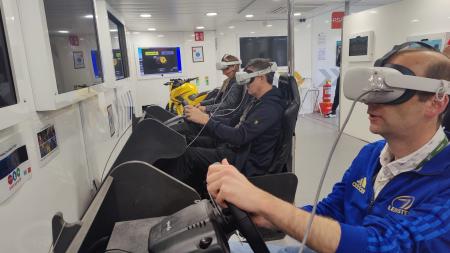
One of the problems faced by every road safety body is that the consequences of drink driving are abstract to people that have never felt them. It’s hard to imagine losing your licence, ending up in prison, killing someone, or being left with permanent disabilities because most of us have never experienced these things. We can logically understand them, but we don’t feel them. For the first time, using Virtual Reality, we could create a shocking and deeply resonant immersive experience and make these consequences feel real.
Data collected by the organisation showed that there had been a resurgence in drink driving in Ireland. A legacy of historical anti-drink driving advertising had reduced the behaviour, but a new cohort of younger people, who have never been exposed to it, were drinking and driving anew. These findings instigated creating a campaign to help reduce this worrying trend against younger adult males who considered themselves invincible and immune to road traffic collisions. For the first time, using Virtual Reality (VR), we could create a shocking and deeply resonant immersive experience and make these consequences feel real.
Our response was ‘Consequences’: a cut-through VR experience that toured the country and challenged the user by putting them in the shoes of a drunk driver, bringing this serious message home in a completely new and immersive way. Different storylines allowed the user to experience the full extent of the agonising consequences of drink driving—from injury to prosecution.
Data collected by the organisation showed that there had been a resurgence in drink driving in Ireland. A legacy of historical anti-drink driving advertising had reduced the behaviour, but a new cohort of younger people, who have never been exposed to it, were drinking and driving anew. These findings instigated creating a campaign to help reduce this worrying trend against younger adult males who considered themselves invincible and immune to road traffic collisions. For the first time, using Virtual Reality (VR), we could create a shocking and deeply resonant immersive experience and make these consequences feel real.
Our response was ‘Consequences’: a cut-through VR experience that toured the country and challenged the user by putting them in the shoes of a drunk driver, bringing this serious message home in a completely new and immersive way. Different storylines allowed the user to experience the full extent of the agonising consequences of drink driving—from injury to prosecution.
Monday, June 24, 2024
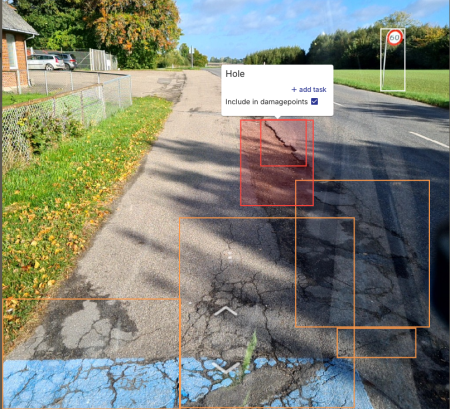
We’re addressing multiple road safety problems:`
- Improving the work safety of road inspectors by reducing time being physically in the middle of the road and reducing multitasking while driving.
- Improving road safety for cars, motorcycles and bicyclist by reducing potholes and defect road inventory such as faded road signs, damaged bollards, etc.
- Improving road safety for pedestrians by mapping crosswalks with worn-out lane markings as well as pavement uplift that causes people to fall.
Image examples can be found attached
- Improving the work safety of road inspectors by reducing time being physically in the middle of the road and reducing multitasking while driving.
- Improving road safety for cars, motorcycles and bicyclist by reducing potholes and defect road inventory such as faded road signs, damaged bollards, etc.
- Improving road safety for pedestrians by mapping crosswalks with worn-out lane markings as well as pavement uplift that causes people to fall.
Image examples can be found attached

Sunday, June 23, 2024
The Mobilidata program addresses the lack of centralized, timely and qualitative real time traffic warnings in the G2B2C ecosystem.
To fulfil the need of road users to receive and be able to cooperate with (return) real time traffic warnings, Mobilidata implemented for the entire Flanders- region and on the entire public road network the European defined C-ROADS standardized Cooperation model of C-ITS or Cooperative ITS. In Mobilidata 31 different use cases are addressed – see overview of all use cases under 7.2 -images
Mobilidata is the Flanders hub where real time road safety related information comes together from these sources:
• Governmental regional and local level: e.g. roadside infrastructure like traffic controllers, variable message signs,
• Private/corporate level: e.g. Directive 2010/40/EU, EU specified SRTI (safety related traffic information) - vehicle sensor based real time warnings.
• Road user ‘community’ based: Events reported, and event feedback generated by road users.
Each of these 3 source information systems has its strengths and weaknesses, offering a neutral environment where they can be combined and distributed to all interested in a non-commercial setting is possible in a road-safety promoting context.
Road safety information in Mobilidata can be clustered in 3 subgroups per topic in the 29 on-street use case list + an extra subgroup of 2 off-street policy related use cases:
• Road regulation & policies
• Warnings / dangerous situations
• Connected infrastructure / traffic lights
To fulfil the need of road users to receive and be able to cooperate with (return) real time traffic warnings, Mobilidata implemented for the entire Flanders- region and on the entire public road network the European defined C-ROADS standardized Cooperation model of C-ITS or Cooperative ITS. In Mobilidata 31 different use cases are addressed – see overview of all use cases under 7.2 -images
Mobilidata is the Flanders hub where real time road safety related information comes together from these sources:
• Governmental regional and local level: e.g. roadside infrastructure like traffic controllers, variable message signs,
• Private/corporate level: e.g. Directive 2010/40/EU, EU specified SRTI (safety related traffic information) - vehicle sensor based real time warnings.
• Road user ‘community’ based: Events reported, and event feedback generated by road users.
Each of these 3 source information systems has its strengths and weaknesses, offering a neutral environment where they can be combined and distributed to all interested in a non-commercial setting is possible in a road-safety promoting context.
Road safety information in Mobilidata can be clustered in 3 subgroups per topic in the 29 on-street use case list + an extra subgroup of 2 off-street policy related use cases:
• Road regulation & policies
• Warnings / dangerous situations
• Connected infrastructure / traffic lights
Saturday, June 22, 2024
Governments and administration need to do more to improve road safety. But, the statistics for road traffic accidents are still shocking. Around 90% of all road accidents are caused by human error. That means every year, about a million people die because of other people's mistakes, carelessness, or irresponsibility. So it makes you wonder, are we doing good enough for road safety? Safe Driving, aims to help and informing whole road users about every single issue in Road Traffic from A to Z.
Wednesday, June 19, 2024
Asociatia Drum Sigur analyzed and researched the following design errors:
- incorrect use of signs for yielding priority in intersections (Give Way and Stop signs) (error found in most countries of the world)
- the formulas used to calculate the length of acceleration/deceleration lanes at road junctions are incorrect (they do not take into account the impact of heavy vehicle traffic, as well as the volume of traffic flows) (error found worldwide)
- the use of staggered pedestrian crossings at traffic lighted intersections has negative effects on pedestrian traffic in most cases. (case analysis for all the staggered pedestrian crossings in Bucharest)
- identification of design and execution errors for T-type intersections, roundabouts, turbo-roundabouts or interchanges in some cities in Romania.
- analyzing some design errors on certain streets in Bucharest and proposing measures to improve road safety and traffic flow.
- incorrect use of signs for yielding priority in intersections (Give Way and Stop signs) (error found in most countries of the world)
- the formulas used to calculate the length of acceleration/deceleration lanes at road junctions are incorrect (they do not take into account the impact of heavy vehicle traffic, as well as the volume of traffic flows) (error found worldwide)
- the use of staggered pedestrian crossings at traffic lighted intersections has negative effects on pedestrian traffic in most cases. (case analysis for all the staggered pedestrian crossings in Bucharest)
- identification of design and execution errors for T-type intersections, roundabouts, turbo-roundabouts or interchanges in some cities in Romania.
- analyzing some design errors on certain streets in Bucharest and proposing measures to improve road safety and traffic flow.
Monday, June 17, 2024
Our experience shows that most road accidents are caused by human error. Various analyses carried out by ALSA show that most road accidents are caused by inappropriate driver behaviour.
In order to manage road safety proactively, it is necessary to have a detailed and rigorous knowledge of the performance and behaviour of each driver in order to know their skills and behaviours, as well as to track their evolution over time.
To this end, ALSA has invested in technology in more than 3,700 vehicles in Spain that allows us to measure speeding, monitor various parameters that reflect driving style and detect various driver behaviours using innovative smart camera technology.
These smart cameras are based on "machine vision” and "artificial intelligence" (MV+IA) systems, which allow us to detect 40 types of driver behaviour and are particularly noteworthy for their innovation.
The data provided by the aforementioned technologies is used to calculate the risk profile of each driver. ALSA defines personalised actions for each driver: training, assignment to certain vehicles and routes, greater follow-up and monitoring, etc.
In addition, each driver has access to the data available on their own performance through an internal app (called "MiAlsa"). In this way, drivers can consult information on their own performance (consumption, driving styles, speeding, incidents, etc.).
In order to manage road safety proactively, it is necessary to have a detailed and rigorous knowledge of the performance and behaviour of each driver in order to know their skills and behaviours, as well as to track their evolution over time.
To this end, ALSA has invested in technology in more than 3,700 vehicles in Spain that allows us to measure speeding, monitor various parameters that reflect driving style and detect various driver behaviours using innovative smart camera technology.
These smart cameras are based on "machine vision” and "artificial intelligence" (MV+IA) systems, which allow us to detect 40 types of driver behaviour and are particularly noteworthy for their innovation.
The data provided by the aforementioned technologies is used to calculate the risk profile of each driver. ALSA defines personalised actions for each driver: training, assignment to certain vehicles and routes, greater follow-up and monitoring, etc.
In addition, each driver has access to the data available on their own performance through an internal app (called "MiAlsa"). In this way, drivers can consult information on their own performance (consumption, driving styles, speeding, incidents, etc.).
Sunday, June 16, 2024
The key objective is to improve the safety of learner drivers and provide a safe driving environment in which learners can practice safe driving skills. In primary research undertaken in 2018, 31% of Advanced Driving Instructors (ADIs) surveyed agreed that the Essential Driver Training programme (EDT) in Ireland did not provide a safe driving environment for learner drivers. Although it is illegal, driving unaccompanied is regularly done by a large percentage of learner drivers. As part of Phase 1 of the Road Safety Strategy (RSS) 2021-2024 a goal has been set to eliminate unaccompanied driving in Ireland by Q4 2024. The Behaviours and Attitudes Survey (2019) found 39% of learner drivers drive unaccompanied. In 2022, 5,929 learner drivers received penalty points for driving unaccompanied.
Ireland has a population of 5.5 million people, on average per year we have 11 fatalities and 45 serious injuries from road collisions with drivers pre-test (2007-2021 data). 80% of fatal collisions involved learner drivers who were driving unsupervised, while 75% of serious injury collisions involved unsupervised learner drivers. We know from research undertaken that collisions involving learner drivers reduce by 80% whilst accompanied. No one should die while learning to drive.
Ireland has a population of 5.5 million people, on average per year we have 11 fatalities and 45 serious injuries from road collisions with drivers pre-test (2007-2021 data). 80% of fatal collisions involved learner drivers who were driving unsupervised, while 75% of serious injury collisions involved unsupervised learner drivers. We know from research undertaken that collisions involving learner drivers reduce by 80% whilst accompanied. No one should die while learning to drive.

Sunday, June 16, 2024
In the Netherlands cycling is the most important way of daily transportation. Sadly, over the past 10 years the amount of bicycle casualties in the Netherlands has increased by 40%, which is expected to increase even more by the popularity of the E-bike. In 2023, 71.000 cyclists were treated in hospitals (60% of all traffic casualties) with 12.500 having traumatic brain injury (16%). Traumatic brain injury often leads to permanent disability as neurons have no or just little recovery potential. A very simple and effective intervention is the voluntary promotion of bicycle helmet with estimated reduction of death 70% and brain injury by 60%. In Denmark, voluntary promotion of bicycle helmets has been very effective in reducing the amount of casualties, especially in children. When we started in 2022 with the first National Day of the bicycle helmet only 2% of the Dutch cyclists were wearing helmets.