
Ireland

Thursday, May 29, 2025
We are addressing several key road safety challenges, particularly the high rates of fatalities and serious injuries on Irish roads, many of which are caused by drink driving. Between 1 January and 24 July 2024, there were 109 fatalities on Irish roads, 17 more than during the same period in 2023. Among these, 43 were drivers and 14 were motorcyclists. One of the major factors contributing to these fatalities is drink driving, with research showing that 37% of driver fatalities (from 2015-2019) involved a positive alcohol test.
To tackle this issue, the Government's Road Safety Strategy Action Plan 2021-2024 has outlined a need for targeted public education campaigns addressing the key causes of death and serious injuries, with a focus on high-risk groups. In April 2024, the Irish Government allocated additional funding to the Road Safety Authority (RSA) to combat the rising number of road deaths.
As part of this effort, we launched a pilot program featuring the Flinebox breathalyzer kiosks, starting at Electric Picnic, Ireland’s largest music festival. It uses advanced Drager alcohol sensor technology, where users blow into a straw, and the result appears on a screen in just 10 seconds. A disclaimer on the screen makes it clear that the breathalyser’s results are for informational purposes only and don’t have legal force. By making this technology easily accessible in social settings like festivals, we aim raise awareness and encourage individuals to make safer, more informed choices before getting behind the wheel
To tackle this issue, the Government's Road Safety Strategy Action Plan 2021-2024 has outlined a need for targeted public education campaigns addressing the key causes of death and serious injuries, with a focus on high-risk groups. In April 2024, the Irish Government allocated additional funding to the Road Safety Authority (RSA) to combat the rising number of road deaths.
As part of this effort, we launched a pilot program featuring the Flinebox breathalyzer kiosks, starting at Electric Picnic, Ireland’s largest music festival. It uses advanced Drager alcohol sensor technology, where users blow into a straw, and the result appears on a screen in just 10 seconds. A disclaimer on the screen makes it clear that the breathalyser’s results are for informational purposes only and don’t have legal force. By making this technology easily accessible in social settings like festivals, we aim raise awareness and encourage individuals to make safer, more informed choices before getting behind the wheel

Thursday, May 29, 2025
Training local authorities, safety auditors, and consultants to understand and implement Safe System principles on Irish road projects. The Safe System approach, which aims to eliminate death and serious injury on roads, requires a fundamental shift in thinking—from blaming individual road users to designing a transport system that anticipates human error and minimizes its consequences. Many professionals involved in road planning and safety in Ireland may not yet be fully familiar with this paradigm or how to apply it effectively in practice. This creates a gap between policy aspirations and on-the-ground implementation. Training must therefore go beyond theoretical understanding; it must equip stakeholders with practical tools, case studies, and methodologies tailored to the Irish context. Additionally, integrating Safe System thinking into all stages of road project development—from planning and design to construction and maintenance—requires cross-sector collaboration and a shared commitment to safety. Overcoming institutional inertia, aligning with existing regulations, and ensuring consistent application across local authorities are further hurdles. Addressing these challenges through targeted education, continuous professional development, and supportive policy frameworks is essential to embedding Safe System principles into Ireland’s road safety culture and achieving long-term reductions in road trauma.

Wednesday, May 28, 2025
In 2024, Kerry County Council’s Road Safety Office launched a series of road safety campaigns, with the lead conference aimed at older road users and aligning with ‘Transportation’ a World Health Organisation Age Friendly Theme. This event was delivered in partnership with Age Friendly Kerry and Older People’s Council Kerry and in association with An Garda Síochána and the Road Safety Authority.
The conference addressed changes in road layouts, signage, speed limits, road traffic laws, and how vehicles and driving habits have changed. It focused on promoting safer driving behaviour. Presentations were delivered in plain language to ensure all attendees could fully engage.
The event offered older drivers an opportunity to share their experiences and raise concerns about their safety on the roads. The event served as an information session and a valuable opportunity for engagement with older road users.
The conference addressed changes in road layouts, signage, speed limits, road traffic laws, and how vehicles and driving habits have changed. It focused on promoting safer driving behaviour. Presentations were delivered in plain language to ensure all attendees could fully engage.
The event offered older drivers an opportunity to share their experiences and raise concerns about their safety on the roads. The event served as an information session and a valuable opportunity for engagement with older road users.

Tuesday, May 13, 2025
For the past 20 years Wexford County Council (in partnership with Rotary Club of Wexford) have presented a unique road safety event entitled Just 1 Life. The programme is targeted at Second Level pupils from all 22 second level schools across County Wexford. The objective of the Just One Life programme is to prevent young drivers’ lives being needlessly lost in road traffic collisions. Described by some as a “shock and awe” approach, the no-holds-barred initiative features a series of interactive videos and presentations from Wexford County Council, An Garda Siochana, the National Ambulance Service, the Health Service Executive, Mental Health Ireland and Wexford Fire Service. Since the start of the initiative over 23,000 Second Level Transition Year pupils from across the county have attended: this year alone in excess of 2,300 pupils will attend our 5 events in the National Opera House. The Just 1 Life Programme contributes to several Sustainable Development Goals (SDGs) outlined in the 2030 Agenda. Firstly, it aligns with SDG 3.6, “aiming to reduce global deaths and injuries from road traffic crashes by half”. By educating teenagers about safe road behaviors, the presentation directly addresses this goal, fostering a culture of responsible road usage among the youth. Additionally, the presentation supports SDG 4.7, promoting education for sustainable development and global citizenship, as it empowers teenagers with crucial knowledge and skills to navigate road risks safely. Furthermore, it contributes to SDG 11.2 by advocating for accessible and safe transportation systems, particularly for vulnerable groups like teenagers. By raising awareness about road safety measures and encouraging responsible behaviour, the presentation helps create safer environments for all road users, aligning with the broader agenda of sustainable urban development and transportation infrastructure. Overall, engaging teenagers in road safety initiatives not only addresses immediate safety concerns but also fosters long-term societal well-being, in line with the holistic objectives of the SDGs.
Monday, June 24, 2024
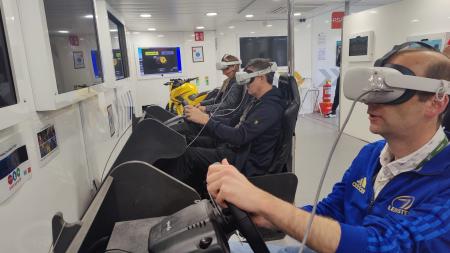
One of the problems faced by every road safety body is that the consequences of drink driving are abstract to people that have never felt them. It’s hard to imagine losing your licence, ending up in prison, killing someone, or being left with permanent disabilities because most of us have never experienced these things. We can logically understand them, but we don’t feel them. For the first time, using Virtual Reality, we could create a shocking and deeply resonant immersive experience and make these consequences feel real.
Data collected by the organisation showed that there had been a resurgence in drink driving in Ireland. A legacy of historical anti-drink driving advertising had reduced the behaviour, but a new cohort of younger people, who have never been exposed to it, were drinking and driving anew. These findings instigated creating a campaign to help reduce this worrying trend against younger adult males who considered themselves invincible and immune to road traffic collisions. For the first time, using Virtual Reality (VR), we could create a shocking and deeply resonant immersive experience and make these consequences feel real.
Our response was ‘Consequences’: a cut-through VR experience that toured the country and challenged the user by putting them in the shoes of a drunk driver, bringing this serious message home in a completely new and immersive way. Different storylines allowed the user to experience the full extent of the agonising consequences of drink driving—from injury to prosecution.
Data collected by the organisation showed that there had been a resurgence in drink driving in Ireland. A legacy of historical anti-drink driving advertising had reduced the behaviour, but a new cohort of younger people, who have never been exposed to it, were drinking and driving anew. These findings instigated creating a campaign to help reduce this worrying trend against younger adult males who considered themselves invincible and immune to road traffic collisions. For the first time, using Virtual Reality (VR), we could create a shocking and deeply resonant immersive experience and make these consequences feel real.
Our response was ‘Consequences’: a cut-through VR experience that toured the country and challenged the user by putting them in the shoes of a drunk driver, bringing this serious message home in a completely new and immersive way. Different storylines allowed the user to experience the full extent of the agonising consequences of drink driving—from injury to prosecution.

Monday, June 24, 2024
Road deaths and serious injuries continued to increase in 2023 and it was projected to have the highest fatalities in six years. Preliminary Analysis of Road Traffic Fatalities from 1 January to 26 July showed that was a 10% increase in road fatalities compared to the same time the previous year. Increases were in driver, passenger and pedestrian deaths and the biggest increased was among those aged 16-25 years old. It also showed the counties that were experiencing the largest increases and that 49% of fatalities occurred between 8pm and 8am in 2023 and almost half of fatalities between Friday and Sunday.
Armed with this information we were challenged to develop a campaign that would help to curb the road fatalities trend in Ireland.
Armed with this information we were challenged to develop a campaign that would help to curb the road fatalities trend in Ireland.
Sunday, June 23, 2024
The challenges we were addressing included:
1. An increase in road fatalities and serious injuries on Irish roads
2. A high number of fatalities in urban areas (between 2018 and 2022 27% of fatalities occurred on an urban road, while 53% of serious injuries occurred on an urban road?
3. Moderate public and political support for lower default speed limits in urban areas. 68% of adults said they would be in favour of them on one or more road., There was only three in situ at the campaign's inception.
Research shows the high risk of speed when a pedestrian or cyclist is hit at 50km/h they have a 50% chance of living or hit at 60kmh, and that chance drops to 10%.
Our challenge was to develop a 30k town campaign to raise awareness of the benefits of a lower default speed limit in urban areas in a bid to garner public support for the implementation of an increased number throughout the country and thus help lower road fatalities and serious injuries in urban areas.
The video shows safe interaction between a number of road users to raise awareness of how lowering the speed limit in urban areas can lead to safer, greener, more livable towns and communities.
1. An increase in road fatalities and serious injuries on Irish roads
2. A high number of fatalities in urban areas (between 2018 and 2022 27% of fatalities occurred on an urban road, while 53% of serious injuries occurred on an urban road?
3. Moderate public and political support for lower default speed limits in urban areas. 68% of adults said they would be in favour of them on one or more road., There was only three in situ at the campaign's inception.
Research shows the high risk of speed when a pedestrian or cyclist is hit at 50km/h they have a 50% chance of living or hit at 60kmh, and that chance drops to 10%.
Our challenge was to develop a 30k town campaign to raise awareness of the benefits of a lower default speed limit in urban areas in a bid to garner public support for the implementation of an increased number throughout the country and thus help lower road fatalities and serious injuries in urban areas.
The video shows safe interaction between a number of road users to raise awareness of how lowering the speed limit in urban areas can lead to safer, greener, more livable towns and communities.
Wednesday, June 19, 2024
Between 2018 and 2022 there where 93 fatalities and 894 serious injury collisions in Irish roads which involved motorcyclists. No specific road safety programme aimed at motorcyclists existed at that time. It was identified that the vast majority of these collisions occurred over the Summer months and almost 50% at weekends and many involved leisure riders or those retuning to motorcycling. Ireland has a large number of rural roads, ideal for leisure riding but this also increases risk through road topography and additional hazards which adversely impact motorcycle safety compared to other road users.
Sunday, June 16, 2024
The key objective is to improve the safety of learner drivers and provide a safe driving environment in which learners can practice safe driving skills. In primary research undertaken in 2018, 31% of Advanced Driving Instructors (ADIs) surveyed agreed that the Essential Driver Training programme (EDT) in Ireland did not provide a safe driving environment for learner drivers. Although it is illegal, driving unaccompanied is regularly done by a large percentage of learner drivers. As part of Phase 1 of the Road Safety Strategy (RSS) 2021-2024 a goal has been set to eliminate unaccompanied driving in Ireland by Q4 2024. The Behaviours and Attitudes Survey (2019) found 39% of learner drivers drive unaccompanied. In 2022, 5,929 learner drivers received penalty points for driving unaccompanied.
Ireland has a population of 5.5 million people, on average per year we have 11 fatalities and 45 serious injuries from road collisions with drivers pre-test (2007-2021 data). 80% of fatal collisions involved learner drivers who were driving unsupervised, while 75% of serious injury collisions involved unsupervised learner drivers. We know from research undertaken that collisions involving learner drivers reduce by 80% whilst accompanied. No one should die while learning to drive.
Ireland has a population of 5.5 million people, on average per year we have 11 fatalities and 45 serious injuries from road collisions with drivers pre-test (2007-2021 data). 80% of fatal collisions involved learner drivers who were driving unsupervised, while 75% of serious injury collisions involved unsupervised learner drivers. We know from research undertaken that collisions involving learner drivers reduce by 80% whilst accompanied. No one should die while learning to drive.
Sunday, June 16, 2024
The main road safety challenge was enforcement of the current European & National legislations.
The install of Vision Heroes Lighting Kit enhances the rear of an LCV (trailers with drop sides or pick up units with drop sides) it greatly improves the presence of units parked with the Original equipped (O/E) rear lamps lit* and the rear doors open to 90’.
This includes rear taillights, Turn Signal & Hazzard’s which are all incorporated within the O/E Lamps.
The install of Vision Heroes Lighting Kit enhances the rear of an LCV (trailers with drop sides or pick up units with drop sides) it greatly improves the presence of units parked with the Original equipped (O/E) rear lamps lit* and the rear doors open to 90’.
This includes rear taillights, Turn Signal & Hazzard’s which are all incorporated within the O/E Lamps.