
Lithuania

Thursday, May 29, 2025
The main road safety challenge that was addressed by the project is driving under the influence (DUI) and the impaired judgement and delayed reaction time as consequences. Driving under the influence of alcohol or drugs significantly impairs a driver's cognitive and motor functions, leading to poor decision-making and slower responses to hazards.
ARV-auto battles this challenge by:
o Creating awareness campaigns: Implementing targeted public education campaigns highlighting the dangers of impaired driving and promoting sober alternatives such as designated drivers and ride-sharing.
o Supporting law enforcement: Collaborating with local police on sobriety checkpoints and enhanced DUI patrols, especially during high-risk periods (e.g., weekends, holidays).
o Doing policy advocacy: Supporting stricter DUI laws, including lower blood alcohol content (BAC) limits and the use of ignition interlock devices for repeat offenders.
ARV-auto battles this challenge by:
o Creating awareness campaigns: Implementing targeted public education campaigns highlighting the dangers of impaired driving and promoting sober alternatives such as designated drivers and ride-sharing.
o Supporting law enforcement: Collaborating with local police on sobriety checkpoints and enhanced DUI patrols, especially during high-risk periods (e.g., weekends, holidays).
o Doing policy advocacy: Supporting stricter DUI laws, including lower blood alcohol content (BAC) limits and the use of ignition interlock devices for repeat offenders.

Wednesday, May 28, 2025
Program design to solve several road safety challenges for higher school students:
1. Expand Knowledge About Safe Road Traffic Practices
Many students lack formal education on road safety beyond basic traffic rules.
• Providing comprehensive road safety theory, including updated traffic laws, defensive driving techniques, and situational awareness.
• Teaching risk assessment skills, such as identifying potential hazards and understanding the impact of speed, fatigue, and distraction.
• Simulations and case studies that help students understand real-world consequences of unsafe driving behaviors.
2. To develop knowledge about the safety and use of micromobility vehicles.
Promote the correct use of bicycles, e-scooters and other micromobility vehicles as an alternative to promote green mobility culture.
• Offering specific modules on micromobility, covering legal regulations, safe riding practices, and correct equipment use (e.g., helmets, lights).
• Demonstrating shared space etiquette, including how to safely interact with pedestrians, cars, and other micromobility users.
• Promoting vehicle maintenance awareness, like checking brakes, battery levels, and tire conditions.
3. Road safety awareness, road culture and sense of responsibility.
Road safety is not only about knowledge and traffic roles, but also about attitudes and behaviors.
• Workshops on respectful and ethical driving, emphasizing patience, empathy, and mutual respect among all road users.
• Addressing aggressive driving behaviors, such as road rage, tailgating, and inappropriate honking.
• Fostering civic responsibility, encouraging students to act as positive role models and promote safe practices in their communities.
1. Expand Knowledge About Safe Road Traffic Practices
Many students lack formal education on road safety beyond basic traffic rules.
• Providing comprehensive road safety theory, including updated traffic laws, defensive driving techniques, and situational awareness.
• Teaching risk assessment skills, such as identifying potential hazards and understanding the impact of speed, fatigue, and distraction.
• Simulations and case studies that help students understand real-world consequences of unsafe driving behaviors.
2. To develop knowledge about the safety and use of micromobility vehicles.
Promote the correct use of bicycles, e-scooters and other micromobility vehicles as an alternative to promote green mobility culture.
• Offering specific modules on micromobility, covering legal regulations, safe riding practices, and correct equipment use (e.g., helmets, lights).
• Demonstrating shared space etiquette, including how to safely interact with pedestrians, cars, and other micromobility users.
• Promoting vehicle maintenance awareness, like checking brakes, battery levels, and tire conditions.
3. Road safety awareness, road culture and sense of responsibility.
Road safety is not only about knowledge and traffic roles, but also about attitudes and behaviors.
• Workshops on respectful and ethical driving, emphasizing patience, empathy, and mutual respect among all road users.
• Addressing aggressive driving behaviors, such as road rage, tailgating, and inappropriate honking.
• Fostering civic responsibility, encouraging students to act as positive role models and promote safe practices in their communities.

Monday, May 12, 2025
At RoadMaster VR, we focus on solving some of the most pressing road safety challenges in the logistics and transport sector. One of the key problems we address is the lack of real-world readiness among new and inexperienced truck drivers. Traditional training often falls short in preparing drivers for critical, high-risk scenarios - such as low visibility, sudden obstacles, maneuvering, or poor road conditions - without exposing them to actual danger.
Another major issue is the inconsistency in training quality across companies and regions. Our VR-based platform ensures standardized, repeatable, and high-quality training experiences for all drivers, regardless of location or instructor.
We also tackle the challenge of low engagement and knowledge retention in conventional training methods. VR simulations significantly increase driver involvement, attention, and retention of critical safety procedures by allowing them to actively experience and respond to real-world situations.
Finally, by collecting and analyzing performance data, we identify high-risk behaviors early and provide personalized feedback - helping drivers improve faster and more effectively.
In short, RoadMaster VR enhances driver preparedness, reduces risk on the road, and supports transport companies in building a safer, more efficient workforce.
Video about RoadMaster VR - https://www.youtube.com/watch?v=rEd8uxqYoAs
Another major issue is the inconsistency in training quality across companies and regions. Our VR-based platform ensures standardized, repeatable, and high-quality training experiences for all drivers, regardless of location or instructor.
We also tackle the challenge of low engagement and knowledge retention in conventional training methods. VR simulations significantly increase driver involvement, attention, and retention of critical safety procedures by allowing them to actively experience and respond to real-world situations.
Finally, by collecting and analyzing performance data, we identify high-risk behaviors early and provide personalized feedback - helping drivers improve faster and more effectively.
In short, RoadMaster VR enhances driver preparedness, reduces risk on the road, and supports transport companies in building a safer, more efficient workforce.
Video about RoadMaster VR - https://www.youtube.com/watch?v=rEd8uxqYoAs

Friday, May 9, 2025
We focus on several key road safety problems related to motorcyclists:
Insufficient real-world riding skills. Many motorcyclists lack the practical skills needed to respond effectively to unexpected or dangerous traffic situations, such as emergency braking, low-speed maneuvering, and obstacle avoidance. These skills are rarely practiced outside of license training.
Overconfidence among riders. Especially for novice or seasonal riders, there is often a dangerous gap between perceived and actual riding ability. This overconfidence can lead to risky decisions on the road.
Lack of safe environments to practice. In Lithuania, there are very few opportunities for riders to improve their control skills in a structured, non-competitive, and safe setting. Without such environments, many riders turn to public roads or unsafe spaces to "practice."
Social pressure and risky riding behavior. Young riders in particular may feel social pressure to show off riding skills or speed on public roads, increasing the risk for themselves and other road users.
Through our activities, motogym.lt provides a safe, engaging space to improve skills, build self-awareness, and promote a safety-first riding culture.
Insufficient real-world riding skills. Many motorcyclists lack the practical skills needed to respond effectively to unexpected or dangerous traffic situations, such as emergency braking, low-speed maneuvering, and obstacle avoidance. These skills are rarely practiced outside of license training.
Overconfidence among riders. Especially for novice or seasonal riders, there is often a dangerous gap between perceived and actual riding ability. This overconfidence can lead to risky decisions on the road.
Lack of safe environments to practice. In Lithuania, there are very few opportunities for riders to improve their control skills in a structured, non-competitive, and safe setting. Without such environments, many riders turn to public roads or unsafe spaces to "practice."
Social pressure and risky riding behavior. Young riders in particular may feel social pressure to show off riding skills or speed on public roads, increasing the risk for themselves and other road users.
Through our activities, motogym.lt provides a safe, engaging space to improve skills, build self-awareness, and promote a safety-first riding culture.
Thursday, April 24, 2025
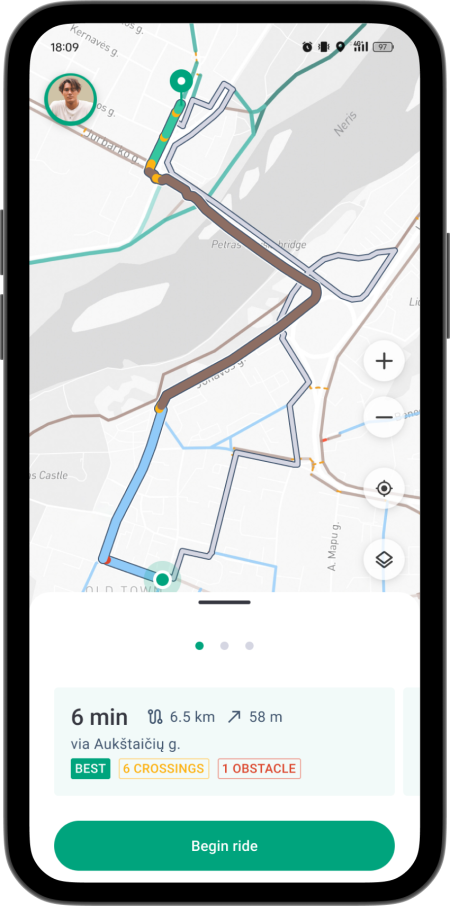
We've developed an app with a safe map for cycling. Routes are made according to quality of infrastructure (user, company gathered and municipalities info), hazards on the road.
Users can report bad infrastructure or good things about it and routes are calculated accordingly.
Users can report bad infrastructure or good things about it and routes are calculated accordingly.
Thursday, June 13, 2024
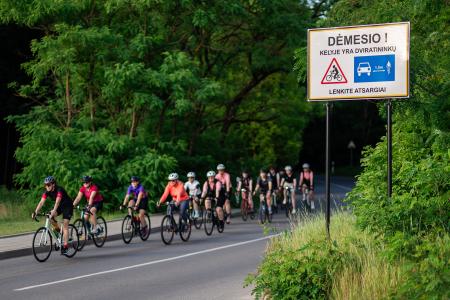
Since our inception in 2017, we have identified major road safety challenges faced by cyclists, primarily related to unsafe overtaking practices. This is a crucial problem, with the number of cyclists steadily increasing each year and many people, particularly in remote areas, relying on cycling for their daily activities. In 2023 alone, eleven cyclists tragically lost their lives in road accidents in Lithuania, an increase from five deaths the year before. In response to these alarming trends, we launched a public campaign targeting both the general public and public authorities. The aim of this campaign is to approve and implement a new road sign that mandates vehicles maintain a safe overtaking distance of at least 1.5 meters from cyclists. This sign, commonly used in many other countries, would be a first for Lithuania.
In collaboration with local authorities, we successfully erected eight such signs in various locations across Lithuania in 2023-2024, largely using our charity funds for this purpose. Our ongoing efforts are now focused on achieving nationwide adoption of this sign, particularly in areas identified as high-risk for cyclists. By doing so, we aim to significantly enhance road safety for cyclists throughout the country.
In collaboration with local authorities, we successfully erected eight such signs in various locations across Lithuania in 2023-2024, largely using our charity funds for this purpose. Our ongoing efforts are now focused on achieving nationwide adoption of this sign, particularly in areas identified as high-risk for cyclists. By doing so, we aim to significantly enhance road safety for cyclists throughout the country.

Thursday, June 13, 2024
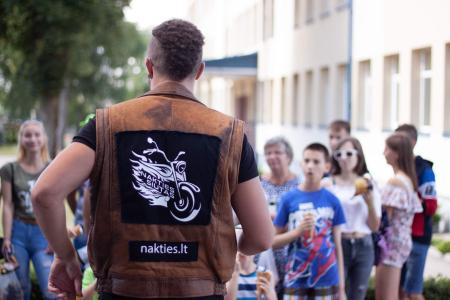
The number of motorcyclists in Lithuania is growing every year. According to the data of 2023, there were ~88,000 motorcycles and mopeds registered in Lithuania. New drivers only receive 10 academic hours of practical driving lessons in schools before they get an A category (motorcycle driving license). In our opinion, this is too little to learn how to ride a motorcycle safely. We emphasize continuous informing of the motorcycling public about safe participation in public traffic. We organize public rides during the season in with 40 to 100 riders are participating. We teach how to properly and safely ride in a motorcycle convoy, what signs to use, how to brake, maintain a constant speed and maintain safe distances between moving motorcycles. These rides are organized free of charge. We also host shows and podcasts on a variety of topics relevant to motorcyclists, including road safety and information for new young motorcycle drivers. A video about the first medical aid to a victim in a moto accident was filmed last year. The plan is to prepare more video material about safe driving, safe motorcycle gear, how to maintain a motorcycle etc.
Wednesday, June 12, 2024
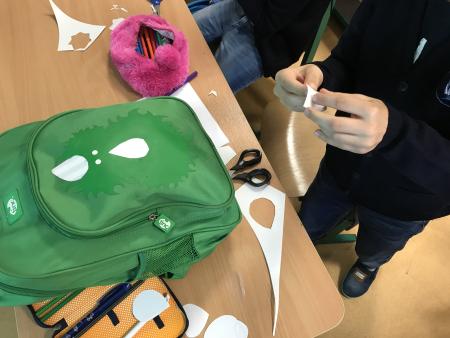
The thing that worked the best was that absolute majority of people who attended our trainings have realized the need to refresh their driving skills annually and keep returning and spreading the word about our program. The challenge that we encountered was that personal safety reflectors get often get lost and need to be distributed annually instead of being a one-off purchase. We also encountered myths among drivers that driving for many years reduces the risk of having accidents, which is not the case and we worked hard to inform them that no matter the experience, drivers should constantly update their skills and knowledge of the traffic rules.
Wednesday, June 22, 2022
Kiekvienais metais kelyje eismo įvykiuose nukenčia arba žūsta vaikai. Pavyzdžiui 2021 metais sužeistų vaikų Lietuvos keliuose iki 15 metų buvo 405, žuvusių 7. Kasmet šis skaičius išlieka panašus ir deja yra per didelis. Dažnai eismo nelaimės įvyksta tamsiuoju paros metu, kai vaikai rudens rytais keliauja į mokyklą. Mažamečiai vaikai dar neturi pakankamų įgūdžių užtikrinti savo saugumą kelyje.

Tuesday, June 21, 2022
Eismo saugumas keliuose labai opi problema. Dėl vairuotojų kaltės įvyksta 65–68% eismo įvykių. Jų įtaka saugiam eismui didžiausia. Tai dažniausiai lemia psichologiniai veiksniai. Pagrindinius eismo įvykius lemiančius veiksnius ir sąlygas galima įvardinti kaip skubėjimas, nuotaikos poveikis, neįvertintas pavojus, dėmesio nuo kelio atitraukimas, nedidelė vairavimo praktika, klaidingas situacijos numatymas, neadekvatūs, situacijos neatitinkantys veiksmai, nepakankamas kelių eismo taisyklių mokėjimas.
„Mokinių ir profesionalų vairavimo meistriškumo konkursas“ – ši saugaus eismo prevencijos iniciatyva tęsiasi nuo 2011 m. Ši iniciatyva skirta jaunimui, kuris gauna vairuotojo teisias ir įsilieja į vairuotojų gretas. Šia iniciatyva stengiamasi prisidėti prie avaringumo kelyje mažinimo, skatinti būsimų vairuotojų atsakingumą, formuoti gerus vairavimo įgūdžius, racionalaus transporto priemonių vairavimo, kultūros ir pagarbos eismo dalyviams.
„Mokinių ir profesionalų vairavimo meistriškumo konkursas“ – ši saugaus eismo prevencijos iniciatyva tęsiasi nuo 2011 m. Ši iniciatyva skirta jaunimui, kuris gauna vairuotojo teisias ir įsilieja į vairuotojų gretas. Šia iniciatyva stengiamasi prisidėti prie avaringumo kelyje mažinimo, skatinti būsimų vairuotojų atsakingumą, formuoti gerus vairavimo įgūdžius, racionalaus transporto priemonių vairavimo, kultūros ir pagarbos eismo dalyviams.