Initiative details
Program design to solve several road safety challenges for higher school students:
1. Expand Knowledge About Safe Road Traffic Practices
Many students lack formal education on road safety beyond basic traffic rules.
• Providing comprehensive road safety theory, including updated traffic laws, defensive driving techniques, and situational awareness.
• Teaching risk assessment skills, such as identifying potential hazards and understanding the impact of speed, fatigue, and distraction.
• Simulations and case studies that help students understand real-world consequences of unsafe driving behaviors.
2. To develop knowledge about the safety and use of micromobility vehicles.
Promote the correct use of bicycles, e-scooters and other micromobility vehicles as an alternative to promote green mobility culture.
• Offering specific modules on micromobility, covering legal regulations, safe riding practices, and correct equipment use (e.g., helmets, lights).
• Demonstrating shared space etiquette, including how to safely interact with pedestrians, cars, and other micromobility users.
• Promoting vehicle maintenance awareness, like checking brakes, battery levels, and tire conditions.
3. Road safety awareness, road culture and sense of responsibility.
Road safety is not only about knowledge and traffic roles, but also about attitudes and behaviors.
• Workshops on respectful and ethical driving, emphasizing patience, empathy, and mutual respect among all road users.
• Addressing aggressive driving behaviors, such as road rage, tailgating, and inappropriate honking.
• Fostering civic responsibility, encouraging students to act as positive role models and promote safe practices in their communities.
1. Expand Knowledge About Safe Road Traffic Practices
Many students lack formal education on road safety beyond basic traffic rules.
• Providing comprehensive road safety theory, including updated traffic laws, defensive driving techniques, and situational awareness.
• Teaching risk assessment skills, such as identifying potential hazards and understanding the impact of speed, fatigue, and distraction.
• Simulations and case studies that help students understand real-world consequences of unsafe driving behaviors.
2. To develop knowledge about the safety and use of micromobility vehicles.
Promote the correct use of bicycles, e-scooters and other micromobility vehicles as an alternative to promote green mobility culture.
• Offering specific modules on micromobility, covering legal regulations, safe riding practices, and correct equipment use (e.g., helmets, lights).
• Demonstrating shared space etiquette, including how to safely interact with pedestrians, cars, and other micromobility users.
• Promoting vehicle maintenance awareness, like checking brakes, battery levels, and tire conditions.
3. Road safety awareness, road culture and sense of responsibility.
Road safety is not only about knowledge and traffic roles, but also about attitudes and behaviors.
• Workshops on respectful and ethical driving, emphasizing patience, empathy, and mutual respect among all road users.
• Addressing aggressive driving behaviors, such as road rage, tailgating, and inappropriate honking.
• Fostering civic responsibility, encouraging students to act as positive role models and promote safe practices in their communities.
Initiative date
Who was/is your target audience?
Young adults 17-25
Topic
Create awareness
Education in school or in community organizations
Knowledge building and sharing
Provide alternative solutions
Training
Organisation details
ARV-Auto
Enterprise
Lithuania
Kaunas
Contact name
Vidmantė Šlepikaitė
Telephone number
+37064209017
vidmanteslepikaite@gmail.com
Website link
Project activities
If you work together with external partners, list the most important partners and briefly describe their role.
Police Officers – Share their real-life experiences on the road. We visit police stations, research laboratories, fingerprint analysis rooms, interrogation rooms, and explore drones and other devices used for incident analysis. The consequences of not following traffic rules are also explained.
Car Showrooms – Introduce the latest car models, combustion engines, equipment, and safety systems. The most recent technologies and systems in newly released cars are presented.
Paramedics – Organize first aid classes, where they teach how to assist injured people on the road. Students learn how to use a car first aid kit, apply a tourniquet, perform artificial respiration, respond to choking incidents, and handle other emergency situations.
Motorsports – During meetings with motorsports participants, discussions focus on the importance of appropriate speed selection and the differences between race cars and vehicles used in everyday traffic.
Driving Instructors – In practical sessions with instructors, students perform special tasks related to car technical inspections. They also have the opportunity to drive a training vehicle in a specially designated enclosed area, practicing starting, lane changes, yielding, and parking maneuvers.
Traffic Psychologists – Share insights into emotional behavior on the road, emotional regulation, respectful traffic culture, and the dangers of driving under the influence of alcohol or drugs.
Car Showrooms – Introduce the latest car models, combustion engines, equipment, and safety systems. The most recent technologies and systems in newly released cars are presented.
Paramedics – Organize first aid classes, where they teach how to assist injured people on the road. Students learn how to use a car first aid kit, apply a tourniquet, perform artificial respiration, respond to choking incidents, and handle other emergency situations.
Motorsports – During meetings with motorsports participants, discussions focus on the importance of appropriate speed selection and the differences between race cars and vehicles used in everyday traffic.
Driving Instructors – In practical sessions with instructors, students perform special tasks related to car technical inspections. They also have the opportunity to drive a training vehicle in a specially designated enclosed area, practicing starting, lane changes, yielding, and parking maneuvers.
Traffic Psychologists – Share insights into emotional behavior on the road, emotional regulation, respectful traffic culture, and the dangers of driving under the influence of alcohol or drugs.
Please describe the project activities you carried/are carrying out and the time period over which these were implemented.
The "Learn to Drive" program was launched in September 2017 and continues to engage students every year across high schools in Lithuania, including Vilnius, Kaunas, Marijampolė, Birštonas, Alytus, Kazlų Rūda, Prienai, Varėna, Lazdijai, Kaišiadorys and other municipalities.
Each school year, we involve more than 1,000 students in the program, where they receive theoretical driving education once a week throughout the academic year. Knowledge acquisition is assessed through online road traffic rules tests.
This theoretical knowledge is further enhanced through practical classes and workshops. In collaboration with police officers and paramedics, we organize specialized sessions on rule compliance and its consequences, as well as first aid on the road.
During hands-on visits to car showrooms, students explore current trends and car models from leading automobile manufacturers.
Additionally, students are introduced to various driving-related topics, such as the driving profession, motorcycle operation, traffic psychology, traffic safety awareness, and more.
Each school year, we involve more than 1,000 students in the program, where they receive theoretical driving education once a week throughout the academic year. Knowledge acquisition is assessed through online road traffic rules tests.
This theoretical knowledge is further enhanced through practical classes and workshops. In collaboration with police officers and paramedics, we organize specialized sessions on rule compliance and its consequences, as well as first aid on the road.
During hands-on visits to car showrooms, students explore current trends and car models from leading automobile manufacturers.
Additionally, students are introduced to various driving-related topics, such as the driving profession, motorcycle operation, traffic psychology, traffic safety awareness, and more.
In terms of implementation, what worked well and what challenges did you need to overcome?
The most effective and engaging activities for children are those that involve practical, hands-on experiences, allowing them to observe and interact with real-life situations. One of the greatest challenges is effectively imparting to students the knowledge and responsibilities associated with driving, while emphasizing that participation in traffic is an essential and routine part of everyday life.
Challenges We Needed to Overcome in the "Learn to Drive" Program:
1. Engaging a Diverse Student Audience
Students come from different backgrounds, learning styles, and levels of prior knowledge. Making the program both engaging and effective for such a wide audience required flexible teaching methods and age-appropriate materials.
2. Maintaining Long-Term Student Interest
Since the program spans an entire school year, sustaining motivation and engagement over time was a key challenge. We addressed this by combining theoretical learning with practical experiences, field trips, and interactive workshops.
3. Coordinating Across Multiple Municipalities
Organizing the program across many locations, such as Vilnius, Kaunas, and smaller towns like Birštonas or Kazlų Rūda, involved complex logistics, scheduling, and coordination with schools
4. Communicating the Importance of Road Safety
Convincing young students to take road safety seriously was another hurdle. To address this, we introduced real-life stories, simulations, and sessions led by police officers and paramedics to demonstrate the consequences of unsafe behavior.
5. Adapting to Changing Regulations and Technologies
With ongoing changes in traffic laws and the rapid evolution of vehicle technologies, we needed to constantly update our curriculum to stay relevant and accurate.
Challenges We Needed to Overcome in the "Learn to Drive" Program:
1. Engaging a Diverse Student Audience
Students come from different backgrounds, learning styles, and levels of prior knowledge. Making the program both engaging and effective for such a wide audience required flexible teaching methods and age-appropriate materials.
2. Maintaining Long-Term Student Interest
Since the program spans an entire school year, sustaining motivation and engagement over time was a key challenge. We addressed this by combining theoretical learning with practical experiences, field trips, and interactive workshops.
3. Coordinating Across Multiple Municipalities
Organizing the program across many locations, such as Vilnius, Kaunas, and smaller towns like Birštonas or Kazlų Rūda, involved complex logistics, scheduling, and coordination with schools
4. Communicating the Importance of Road Safety
Convincing young students to take road safety seriously was another hurdle. To address this, we introduced real-life stories, simulations, and sessions led by police officers and paramedics to demonstrate the consequences of unsafe behavior.
5. Adapting to Changing Regulations and Technologies
With ongoing changes in traffic laws and the rapid evolution of vehicle technologies, we needed to constantly update our curriculum to stay relevant and accurate.
Evaluation
Please summarise how you have evaluated the initiative’s impact (e.g. social media reach, survey, feedback forms, statistics).
1. Annual Program Evaluation Survey
At the conclusion of each program year, an anonymous survey is conducted to assess the program’s effectiveness, relevance, and areas for improvement. The survey focuses on key aspects such as overall program evaluation, its usefulness in preparing for obtaining a driver's license, and participant suggestions for enhancing the program’s content and delivery.
2. Availability of Traffic Rules Test Statistics
Teachers participating in the program have access to comprehensive traffic rules test statistics. Throughout the academic year, they can monitor each student's learning progress. An online testing platform is provided, enabling teachers to review individual test results, including completion time, scores, common mistakes, and the specific topics associated with those errors.
At the conclusion of each program year, an anonymous survey is conducted to assess the program’s effectiveness, relevance, and areas for improvement. The survey focuses on key aspects such as overall program evaluation, its usefulness in preparing for obtaining a driver's license, and participant suggestions for enhancing the program’s content and delivery.
2. Availability of Traffic Rules Test Statistics
Teachers participating in the program have access to comprehensive traffic rules test statistics. Throughout the academic year, they can monitor each student's learning progress. An online testing platform is provided, enabling teachers to review individual test results, including completion time, scores, common mistakes, and the specific topics associated with those errors.
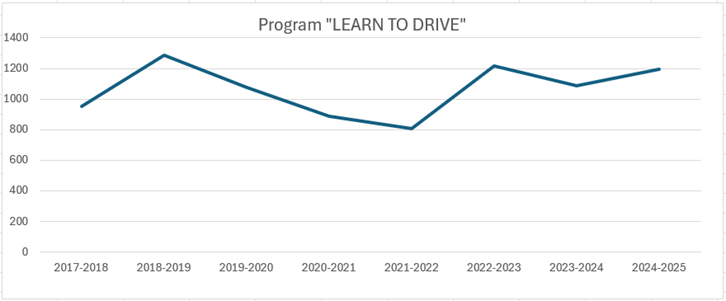
What has been the effect of the activities?
Educational year - Students
2017-2018 - 955
2018-2019 - 1285
2019-2020 - 1075
2020-2021 - 888
2021-2022 - 805
2022-2023 -1218
2023-2024 -1089
2024-2025 - 1194
Since its launch in 2017, the "Learn to Drive" program has reached over 7,000 students across Lithuania, engaging youth in cities and municipalities such as Vilnius, Kaunas, Marijampolė, Alytus, and beyond. The program has significantly raised awareness of road safety and responsible driving among young people. While direct correlations to national accident statistics are complex, participating schools have reported improved knowledge and safer behavior among students.
Impact is measured through annual anonymous surveys, feedback from teachers, and performance data from online traffic rule tests. These tools help track student progress, identify knowledge gaps, and continuously improve program delivery.
The program’s effectiveness lies in its practical, interdisciplinary approach—combining theoretical knowledge with hands-on workshops, cooperation with police, paramedics, and traffic psychologists. It complements national road safety initiatives by targeting young, pre-license-age students—helping build awareness before bad habits form. Regionally, the program has unified efforts across municipalities, while its model has attracted interest from educators in neighboring countries, hinting at international potential.
Overall, "Learn to Drive" is a scalable, cost-efficient initiative that fills a crucial gap in early driver education and traffic awareness.
2017-2018 - 955
2018-2019 - 1285
2019-2020 - 1075
2020-2021 - 888
2021-2022 - 805
2022-2023 -1218
2023-2024 -1089
2024-2025 - 1194
Since its launch in 2017, the "Learn to Drive" program has reached over 7,000 students across Lithuania, engaging youth in cities and municipalities such as Vilnius, Kaunas, Marijampolė, Alytus, and beyond. The program has significantly raised awareness of road safety and responsible driving among young people. While direct correlations to national accident statistics are complex, participating schools have reported improved knowledge and safer behavior among students.
Impact is measured through annual anonymous surveys, feedback from teachers, and performance data from online traffic rule tests. These tools help track student progress, identify knowledge gaps, and continuously improve program delivery.
The program’s effectiveness lies in its practical, interdisciplinary approach—combining theoretical knowledge with hands-on workshops, cooperation with police, paramedics, and traffic psychologists. It complements national road safety initiatives by targeting young, pre-license-age students—helping build awareness before bad habits form. Regionally, the program has unified efforts across municipalities, while its model has attracted interest from educators in neighboring countries, hinting at international potential.
Overall, "Learn to Drive" is a scalable, cost-efficient initiative that fills a crucial gap in early driver education and traffic awareness.
Please briefly explain why your initiative is a good example of improving road safety.
Older students are among the most vulnerable participants in traffic. They are mature enough to understand traffic culture and are at the ideal age to begin learning and preparing to become independent drivers. This is the most appropriate time to study the rules of the road. At this stage, students are especially eager to absorb knowledge and prepare for their future roles as responsible drivers. Therefore, we aim to instill a correct understanding of traffic culture and nurture conscious, responsible drivers.
Organizing and involving multiple institutions in the program is challenging, but each partner brings a unique perspective that broadens the future driver’s understanding of traffic and road safety. Their contributions enrich the learning experience by highlighting different aspects of traffic participation.
It is valuable to include diverse topics in the program that promote awareness and understanding of all road users. The content is expanded beyond basic driving instruction and traffic rules to include a broader view—featuring input from traffic psychologists, paramedics, police officers, professional racers, motorcycle club members, automotive experts and engineers, as well as representatives of sustainable urban development. This multidisciplinary approach strengthens the overall impact of the program.
Organizing and involving multiple institutions in the program is challenging, but each partner brings a unique perspective that broadens the future driver’s understanding of traffic and road safety. Their contributions enrich the learning experience by highlighting different aspects of traffic participation.
It is valuable to include diverse topics in the program that promote awareness and understanding of all road users. The content is expanded beyond basic driving instruction and traffic rules to include a broader view—featuring input from traffic psychologists, paramedics, police officers, professional racers, motorcycle club members, automotive experts and engineers, as well as representatives of sustainable urban development. This multidisciplinary approach strengthens the overall impact of the program.
How have you shared information about your project and its results?
We share information through public schools and municipal websites at both national and regional levels. At the end of each year, we also provide a detailed report to municipalities and schools outlining the activities carried out and the results achieved.
Additionally, we share updates and engage with the public through social media platforms such as Facebook and Instagram.
Additionally, we share updates and engage with the public through social media platforms such as Facebook and Instagram.